Choosing the best country to register a company in Europe is not only about taxes. Founders also need to consider how easy it is to incorporate, whether the company can be managed remotely, what the ongoing compliance burden looks like, and whether the chosen jurisdiction supports long-term international growth.
For many international founders, Estonia stands out as one of the most practical options in Europe. It combines a modern digital environment, relatively simple administration, access to the European Union, and a corporate tax system that is especially attractive for companies focused on reinvestment and growth. If you are exploring company formation in Estonia, it is worth comparing Estonia with other popular jurisdictions before making a final decision.
What Is the Best Country to Register a Company in Europe?
There is no single best country to register a company for everyone. The right jurisdiction depends on your business model, where your clients are located, whether you need an EU company, how important remote administration is, and how much bureaucracy you are prepared to handle.
That said, Estonia is often one of the strongest choices for non-resident founders, digital businesses, service-based companies, consultants, agencies, and cross-border entrepreneurs who want an EU legal entity with relatively efficient administration. It is especially attractive for founders who value simplicity, digital tools, and a tax system that does not tax retained corporate profits.
What Should You Compare Before Starting a Company?
Before deciding where to register a company, it is useful to compare jurisdictions using practical criteria rather than marketing slogans.
Ease of incorporation
Some countries offer a more straightforward registration process than others. Founders should look at how many steps are involved, whether the setup can be completed remotely, how long it usually takes, and whether the process is understandable for non-residents.
Remote setup and administration
For international founders, the ability to register and manage a company remotely can be a major advantage. In some jurisdictions, digital tools are well developed. In others, the process still depends heavily on local paperwork, physical presence, or slower administrative routines.
Tax approach
Tax should never be the only factor, but it matters. Founders usually compare corporate taxation, dividend taxation, VAT implications, and how friendly the system is to reinvestment and growth.
Ongoing compliance burden
The country that is easy to enter is not always easy to maintain. Annual reporting, bookkeeping requirements, corporate maintenance, and local administrative obligations should all be part of the decision.
Access to the EU market
If your business serves clients across Europe, registering a company in an EU member state may offer clear structural advantages. This can be particularly relevant for credibility, contractual relationships, and cross-border operations.
Suitability for non-residents
Some jurisdictions are more practical for foreign founders than others. The legal framework may allow non-resident ownership, but the real question is whether the system is genuinely workable in practice.
Banking and business credibility
A company is not just a registration certificate. Founders also need to think about how the jurisdiction is viewed by banks, payment institutions, partners, suppliers, and clients.
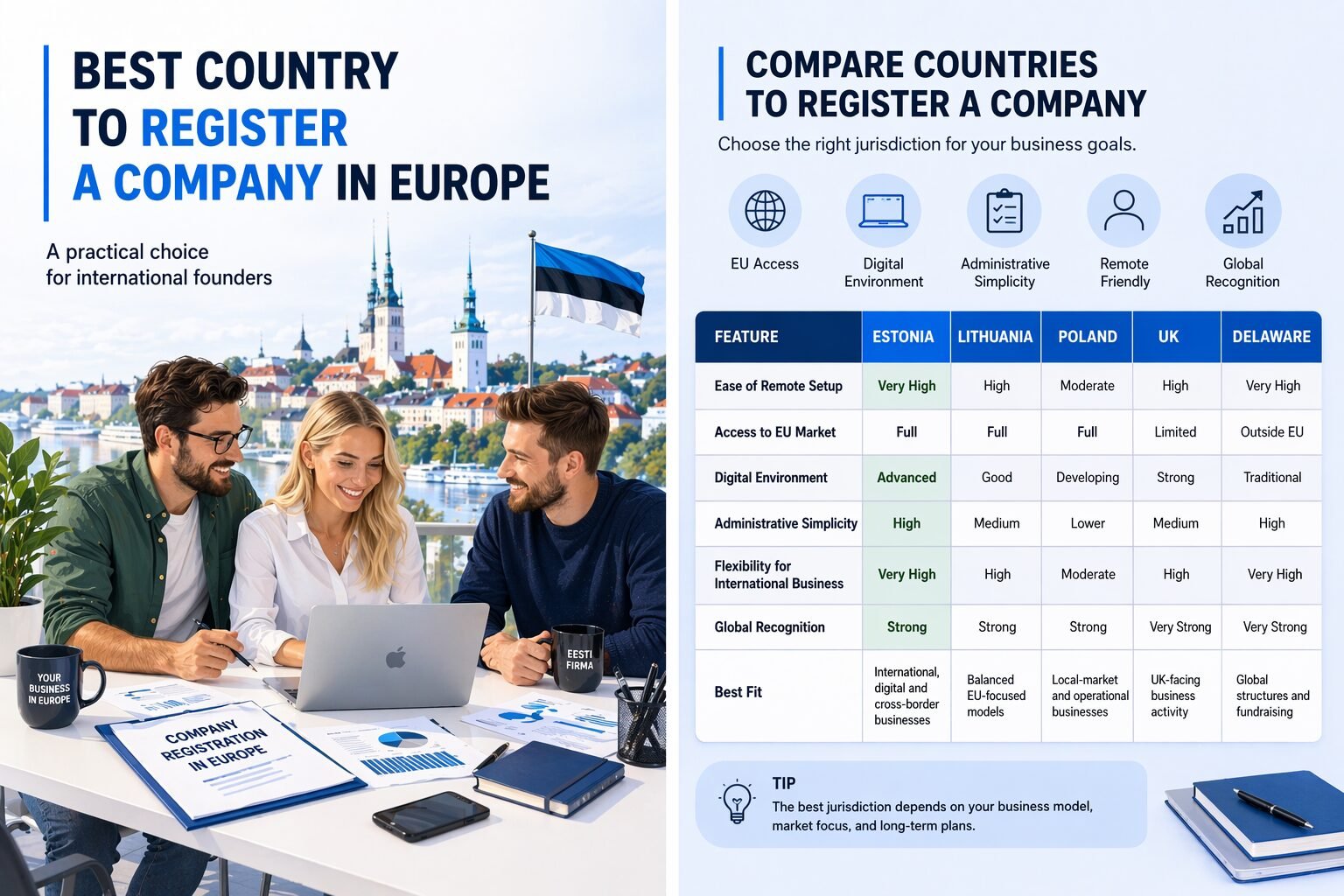
This table is intentionally practical rather than overly technical. No jurisdiction is perfect in every category. The right choice depends on what you are trying to build and where you plan to operate.
Why Estonia Stands Out for Company Formation
Estonia has earned a strong reputation among international founders because it offers a combination that is still relatively rare in Europe: digital-first administration, a clear legal framework, a business-friendly tax model, and practical accessibility for non-residents.
Simple and relatively fast company registration
Compared with many other jurisdictions, Estonia is often seen as more straightforward for company formation. Founders who value an efficient setup process often appreciate the country’s digital approach and administrative clarity.
This does not mean every case is identical or that every structure can be created instantly. However, Estonia is widely regarded as one of the more convenient European jurisdictions for setting up a company, especially when the business model is not overly complex.
Remote management and digital administration
One of Estonia’s biggest advantages is that the country has built a strong digital environment around both public administration and business operations. This is one of the reasons why it is frequently considered by founders who live outside Estonia but want an EU company.
For many international entrepreneurs, the appeal is not just registration itself, but the ability to manage core corporate matters with less friction than in more traditional systems.
0% corporate tax on retained earnings
One of the best-known features of Estonia is its corporate tax model. Retained and reinvested profits are generally not subject to corporate income tax in the same way as in many other jurisdictions. This makes Estonia especially attractive for founders who want to grow the business, reinvest into operations, and avoid immediate tax leakage at the company level on undistributed profits.
For companies focused on scaling rather than distributing profits quickly, this can be a meaningful structural advantage.
EU legal framework and access to the single market
Estonia is a member of the European Union, which makes it especially relevant for founders who want a European legal base. In many cases, an EU company can be a practical solution for service agreements, cross-border operations, and broader access to the European market environment.
This does not automatically solve every regulatory or tax question, but it is one of the reasons Estonia is often part of the conversation when founders compare European jurisdictions.
A strong option for non-resident founders
Estonia is particularly attractive for founders who do not live in the country but want a European company. That is one of the reasons why the jurisdiction is often discussed in the context of digital entrepreneurship, remote management, and international business structures.
For non-residents, Estonia can be easier to understand and operate than more paper-heavy or locally oriented systems.
Estonia vs Other Popular Countries for Company Setup
A useful way to evaluate Estonia is to compare it directly with other jurisdictions founders often consider.
Estonia vs Lithuania
Registering a company Lithuania is a serious EU alternative and may work well in certain cases. It can be suitable for founders looking at a European structure and may be attractive depending on operational specifics.
However, Estonia is often perceived as more internationally visible in the context of digital company formation and remote management. For founders who prioritize administrative simplicity and strong digital processes, Estonia may feel more intuitive.
Estonia vs Poland
Poland is an important market and can be a practical jurisdiction if the business is clearly focused on Polish operations, local staff, local clients, or strong physical presence there.
Estonia, by contrast, is often more appealing for lean international structures, especially where the founder values remote management, cross-border service delivery, and a more flexible administrative environment.
Estonia vs the UK
The UK can still be attractive for founders targeting the British market or working in commercial contexts where a UK company is commercially familiar and relevant.
But for founders specifically looking for an EU company, Estonia often has a stronger strategic position. It may be more suitable where EU access, European legal presence, and digital-first administration matter more than UK market positioning.
Estonia vs Delaware
Delaware is highly recognizable in the US ecosystem and may make sense for founders pursuing a US-oriented structure, especially where investor expectations are shaped by American legal norms.
Estonia is usually the more natural option when the goal is to establish a practical European company. For EU-focused operations, international services, remote-first teams, and digital business models, Estonia often offers a more suitable foundation.
Who Should Choose Estonia for Company Formation?
Estonia is often a strong choice for:
- non-resident founders who want an EU company;
- consultants, agencies, and service providers working across borders;
- SaaS, IT, and digital product businesses;
- online-first businesses that do not depend on a heavy local physical footprint;
- founders who value remote administration and a modern digital environment;
- entrepreneurs who want a relatively efficient jurisdiction for long-term international business structuring.
In many of these cases, Estonia is attractive not because it promises something magical, but because it offers a practical balance of accessibility, credibility, administrative clarity, and tax logic.
When Estonia May Not Be the Best Place for a Company
A strong article should say this clearly: Estonia is not the right choice for everyone.
Another jurisdiction may be more practical if:
- your business is deeply tied to one local market outside Estonia;
- your operations depend on a strong physical presence in another country;
- your regulatory or licensing requirements are centered elsewhere;
- you need a structure shaped specifically around US fundraising expectations;
- your company’s real day-to-day operations are concentrated in another jurisdiction.
For example, a founder building around the Polish domestic market may find Poland more practical in some cases. A startup targeting US venture capital may prefer Delaware. A business focused primarily on UK clients may find a UK structure more commercially natural.
The goal is not to force every business into Estonia. The goal is to choose the jurisdiction that best matches the real structure of the company.
Final Verdict: Is Estonia One of the Best Countries?
Estonia is not automatically the best country to register a company for every founder. But for many international entrepreneurs, digital businesses, consultants, service providers, and non-resident founders, it is one of the most practical and appealing jurisdictions in Europe.
Its advantages are clear: a modern digital environment, relatively efficient administration, a respected EU legal framework, and a corporate tax model that supports reinvestment and growth. If your business model is international, service-based, remote-friendly, or EU-oriented, Estonia deserves serious consideration.
If you are comparing jurisdictions and want a practical legal base in Europe, it may make sense to explore how to register a company in Estonia in a way that fits your business model and long-term plans.
FAQ | Frequently Asked Questions
Below are answers to commonly asked questions about starting, managing, and operating a business, based on typical inquiries received by our specialists.
- What is the best country to register a company in Europe?
The best country to register a company in Europe depends on your business model and target market. Popular options include Estonia, Lithuania, Poland, and the UK, each offering different advantages for international founders and company formation.
- Which country in Europe has the easiest company registration process?
Countries with digital systems and lower bureaucracy usually offer the easiest company registration. Some European jurisdictions allow remote company formation, making the process faster and more accessible for non-residents.
- Can foreigners register a company in Europe remotely?
Yes, many European countries allow foreigners to register a company remotely. The level of convenience depends on the jurisdiction, local requirements, and access to digital administration tools.
- What is the cheapest country to register a company in Europe?
The cheapest country to register a company in Europe depends on setup costs, ongoing compliance, and taxation. Low-cost registration does not always mean the most efficient long-term business solution.
- Is it better to register a company in the EU or outside the EU?
Registering a company in the EU is often better for businesses targeting European clients, as it provides access to the single market and a stable legal framework. However, non-EU jurisdictions may be suitable for specific regional strategies.
- Is Estonia a good country for company formation?
Yes, Estonia is considered one of the best countries in Europe for company formation, especially for digital and international businesses. It is known for its efficient administration and strong suitability for non-resident founders.
Note: The FAQ is provided for general informational purposes only and does not constitute legal, tax, or financial advice. Requirements and procedures may vary depending on jurisdiction, business model, and individual circumstances.