When setting up a company in Estonia, one of the first decisions founders face is choosing the appropriate business structure. Although the registration process is relatively straightforward, the selected entity type determines how the business operates, how risk is managed, and how the company can grow over time.
In practice, only a limited number of Estonian legal entity types are commonly used for commercial activity, while others are relevant mainly for specific or non-commercial purposes.
This article provides an overview of the main legal entity types in Estonia, their key characteristics, and how they are typically used in real business scenarios.
Distribution of Company Types in Estonia
Estonian law recognises several legal entity types, but only a limited number are commonly used for business activity. When entrepreneurs plan company formation in Estonia, the choice of entity affects liability, governance, capital requirements, and the overall flexibility of the business.
The overview below shows the distribution of registered legal entity forms in Estonia and helps explain why the private limited company (OÜ) remains the dominant structure for commercial activity.
This distribution reflects actual business practice in Estonia, where the OÜ is the standard legal form for most commercial activities.
Breakdown of Registered Legal Entities in Estonia
The chart shows that the vast majority of registered business entities in Estonia are private limited companies (OÜ), which is why this legal form is generally the main choice for founders starting a business in Estonia.
The choice of legal form when establishing a company in Estonia is governed by the Commercial Code. In practice, however, only certain structures are relevant for commercial activity, foreign founders, and scalable business operations.
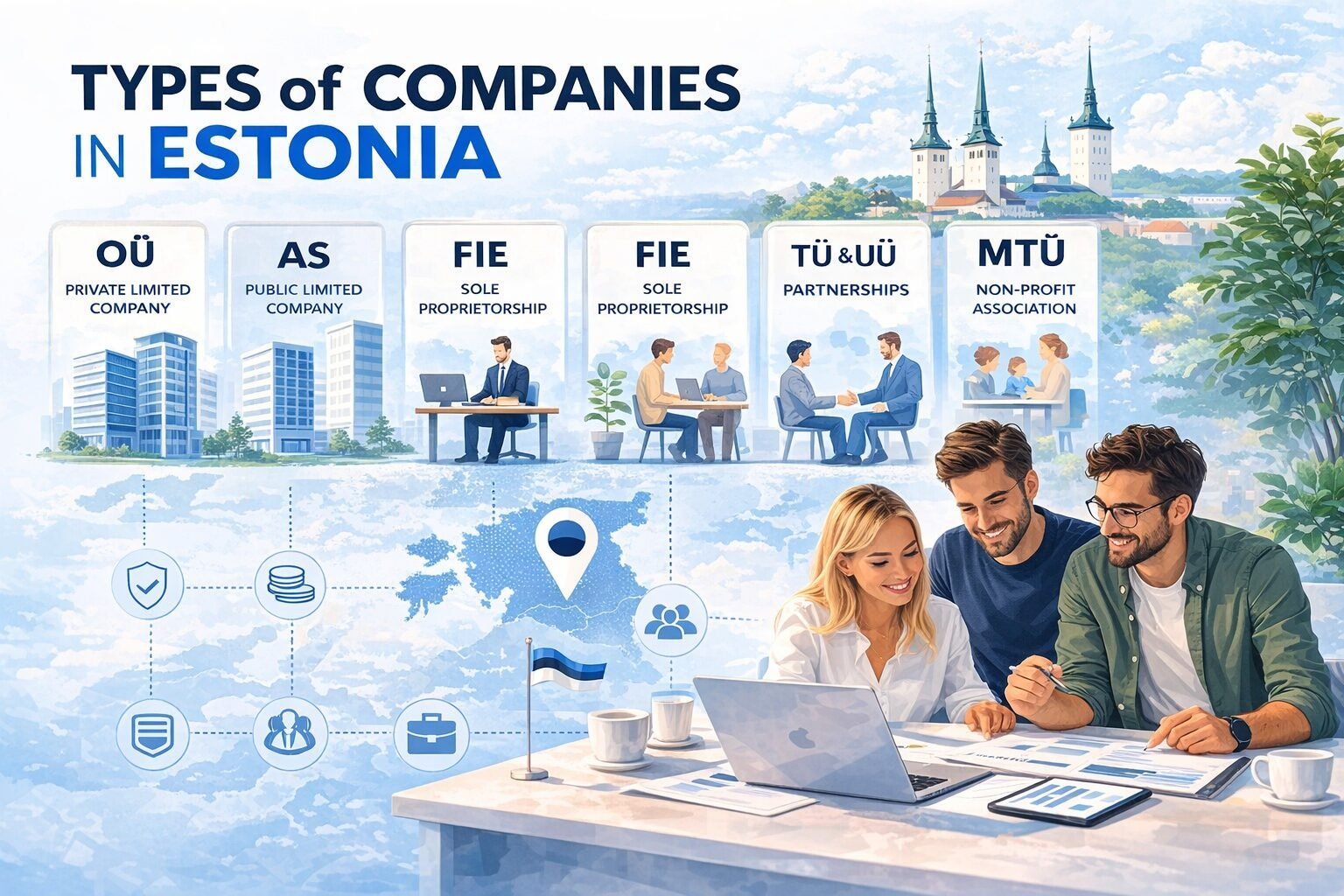
Main Types of Companies and Legal Entities in Estonia
The following section outlines the main legal entity types used in Estonia, together with their practical characteristics and typical use cases in real business scenarios.
OÜ – Private Limited Company
The OÜ (osaühing) is the most common legal form for business in Estonia and the standard choice for company formation by both local and international founders. It is a limited liability company, which means that shareholders are generally liable only up to the amount of their contribution.
This form is widely used because it combines flexibility, relatively simple governance, and suitability for small, medium-sized, and even more advanced business structures. An OÜ can be incorporated by one or more shareholders and is commonly used for service businesses, trading companies, holding structures, IT projects, and cross-border operations.
In practice, the OÜ is usually the most suitable structure for entrepreneurs who want a scalable, credible, and commercially practical company form in Estonia.
AS – Public Limited Company
The AS (aktsiaselts) is a public limited company structure typically used for larger businesses, more formal corporate structures, or projects involving a more substantial capital base. This form requires a higher minimum share capital and a more complex governance model than an OÜ.
An AS must usually have both a management board and a supervisory board, which makes it more suitable for businesses with multiple investors, institutional participation, or more developed internal corporate governance requirements.
For most small and medium-sized businesses, the AS is not the default choice, but it may be relevant in cases where the company plans significant growth, larger investments, or a more formal shareholding structure.
TÜ and UÜ – Partnerships
Estonian law also provides for partnership structures, including the general partnership (TÜ) and the limited partnership (UÜ). These forms are used much less frequently in modern business practice, especially in projects involving international founders.
In a TÜ, partners generally bear joint and unlimited liability for the obligations of the partnership. In a UÜ, at least one partner has unlimited liability, while limited partners are liable only up to the amount of their contribution.
Because of the liability exposure and narrower commercial use, partnership structures are generally chosen only in specific cases where the business model or the relationship between partners makes this form appropriate.
FIE – Sole Proprietorship
The FIE (füüsilisest isikust ettevõtja) is a form of individual entrepreneurship rather than a separate limited liability company. A person registered as FIE carries out business under their own name and remains personally liable for all obligations arising from that activity.
This structure may be suitable for some small-scale local activity, freelance work, or individual professional services. However, it is generally less attractive for founders who want to build a scalable business, manage risk, or work with international partners and clients.
For that reason, foreign entrepreneurs usually prefer the OÜ instead of registering as an FIE.
MTÜ – Non-Profit Association
The MTÜ is a non-profit association intended for non-commercial purposes. It is suitable for associations, clubs, foundations of community interest, and similar activities where the goal is not the distribution of profit to shareholders.
Unlike a business company, an MTÜ has members instead of shareholders, and any surplus must be used in line with the organisation’s statutory objectives rather than distributed as profit.
Although it is an important legal form in Estonia, it is not generally relevant for entrepreneurs seeking standard company formation for business purposes.
How to Choose the Right Legal Form in Estonia
In practice, the choice of legal structure in Estonia is not only a formal step but a strategic decision that affects how your business operates, scales, and manages risk over time. Selecting the appropriate legal form at the outset can significantly reduce future restructuring and compliance complexity.
The decision typically depends on several key factors:
- Liability protection — whether founders want to separate personal assets from business obligations
- Business scale — small individual activity versus a structured and scalable company model
- Investment plans — whether external investors, share transfers, or equity structuring are expected
- Regulatory complexity — governance requirements, reporting obligations, and internal structure
- International operations — suitability for cross-border activity within the EU and beyond
For most entrepreneurs — especially international founders — these factors lead to the same practical conclusion: a structure is needed that combines limited liability, flexibility, and credibility in an EU business environment.
In this context, the Estonian OÜ provides the most balanced and efficient solution for the majority of commercial activities.
Why OÜ Is the Preferred Structure
The dominance of the OÜ structure in Estonia is not coincidental. It reflects a legal and business framework that is specifically designed to support modern, digital, and internationally oriented companies.
The OÜ combines several key advantages that make it the default choice for founders:
- Limited liability — shareholders are generally not personally liable for company obligations
- Low entry threshold — flexible share capital requirements suitable for early-stage businesses
- Remote incorporation — full registration possible via e-Residency or power of attorney
- Tax efficiency — 0% corporate tax on retained and reinvested profits
- Flexible governance — no mandatory supervisory board for standard structures
In addition, the OÜ is widely recognised by banks, partners, and service providers across the European Union, which simplifies onboarding, payments, and international operations.
As a result, the private limited company (OÜ) has become the standard legal form for startups, consultants, IT companies, holding structures, and international entrepreneurs operating in Estonia.
Need Help Choosing the Right Company Type in Estonia?
If you are planning to register a company in Estonia and are unsure which legal form is appropriate for your business model, our team can help you assess the available options and choose the most practical structure for your goals.
In most cases, an OÜ is the preferred solution, but the final choice should depend on your ownership structure, liability considerations, operational plans, and long-term strategy.
Choosing the right structure at the beginning can significantly simplify your business operations and reduce legal risks in the future.
FAQ | Frequently Asked Questions
Below are answers to commonly asked questions about starting, managing, and operating a business, based on typical inquiries received by our specialists.
- What company types exist in Estonia?
Estonia recognises several legal entity types, including OÜ, AS, TÜ, UÜ, FIE and MTÜ. However, only some of them are commonly used for commercial activity, while others are intended for specific or non-commercial purposes.
- Which company type is the most common in Estonia?
The private limited company (OÜ) is by far the most common company type in Estonia. It is widely used because it offers limited liability, a flexible structure, and practical suitability for most business activities.
- What is the main difference between OÜ and AS?
The main difference is scale and governance. An OÜ is typically used for standard business activity, while an AS is intended for larger companies with higher capital requirements and a more formal management structure.
- Are partnerships commonly used in Estonia?
Partnerships such as TÜ and UÜ exist under Estonian law, but they are used much less often than OÜs. They are generally relevant only in specific cases due to their different liability structure.
- Is a sole proprietorship the same as a company in Estonia?
No, a sole proprietorship (FIE) is not the same as a limited liability company. It is a form of individual entrepreneurship where the person conducts business under their own name and remains personally liable.
- Is an MTÜ a company type for business activity?
No, an MTÜ is a non-profit association and is not intended for standard commercial business. It is used for non-commercial purposes, such as associations, clubs, and other member-based activities.
- Why is it important to understand company types before choosing one?
Different company types in Estonia have different rules on liability, governance, capital, and practical use. Understanding these differences helps founders choose a structure that matches their business model and long-term goals.
Note: The FAQ is provided for general informational purposes only and does not constitute legal, tax, or financial advice. Requirements and procedures may vary depending on jurisdiction, business model, and individual circumstances.