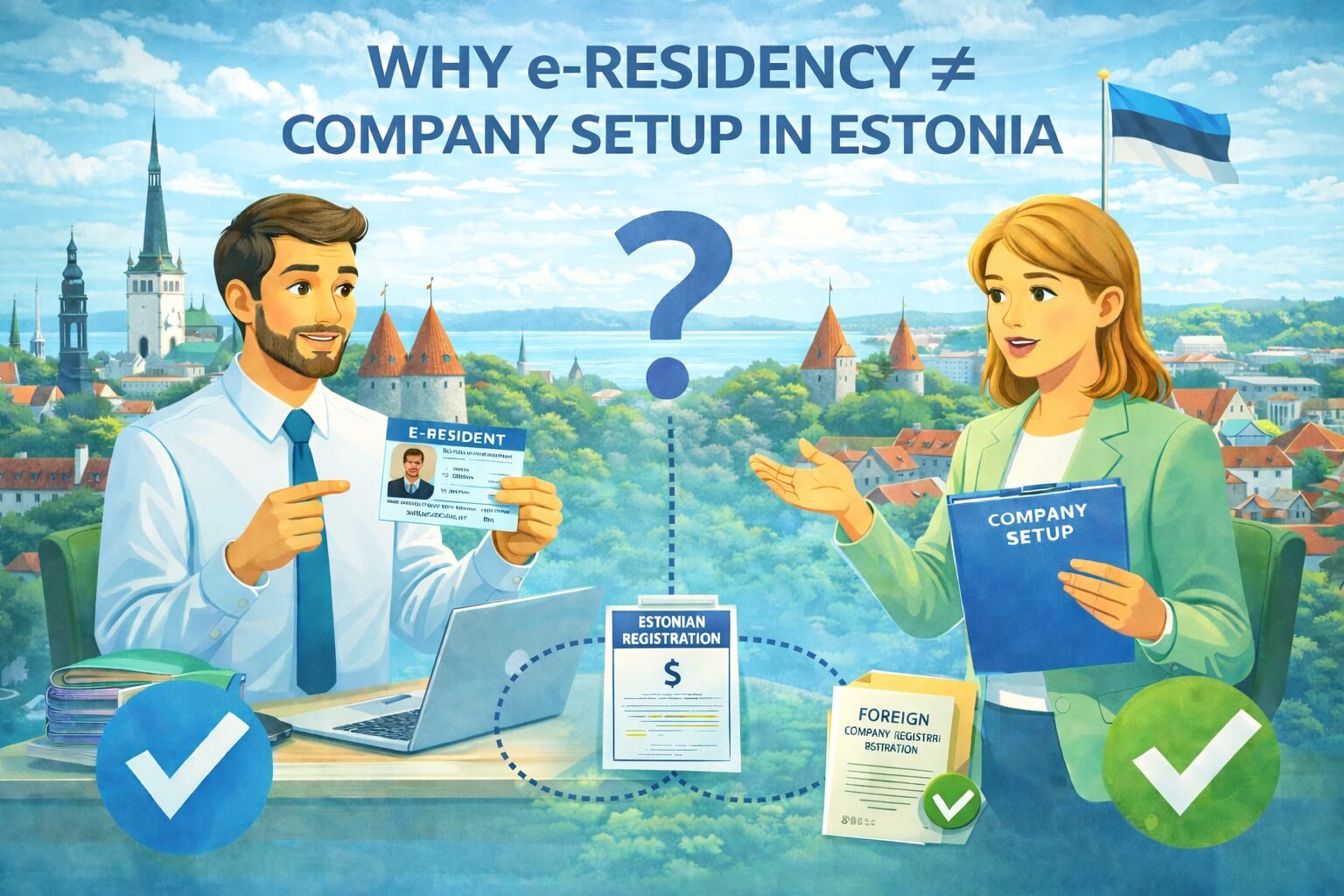
Quick overview: e-Residency is a digital identification and access tool, not a legal method of company formation. In Estonia, a company may be registered online, in person before a notary, or remotely via a power of attorney, with or without e-Residency. This article explains the legal distinction between e-Residency and company setup and why understanding this difference is important for proper legal and compliance planning.
Estonia is widely recognised as one of the most digitally advanced jurisdictions in the European Union, particularly in the area of online business administration. A key component of this digital ecosystem is e-Residency, a state-issued digital identification solution that enables foreign individuals to access Estonian public e-services remotely.
At the same time, e-Residency is often mistakenly perceived as a form of company registration in Estonia. From a legal perspective, this assumption is inaccurate. While e-Residency facilitates digital access and electronic signing, it does not constitute company registration and is not the only legally valid method to establish and operate an Estonian company.
This article explains the legal difference between e-Residency and company formation, outlines the available company registration methods in Estonia, and clarifies why understanding this distinction is essential for proper legal and compliance planning. This perspective is further complemented by a recent article on choosing corporate services in Estonia, which highlights that company formation and ongoing corporate support are not limited to automated platform-based providers focused on e-Residents, and that alternative professional service models remain widely used in practice.
What e-Residency Is from a Legal Perspective
e-Residency is a state-issued digital identification solution provided by the Republic of Estonia to non-residents in accordance with the Identity Documents Act. From a legal standpoint, its core function is to enable secure authentication and the use of a qualified electronic signature within Estonian digital infrastructure.
In practical terms, e-Residency allows an individual to:
- digitally identify themselves in Estonian state portals;
- sign documents electronically with legal effect;
- access public services such as the e-Business Register;
- manage selected corporate and administrative procedures online.
It is important to emphasise that e-Residency does not confer residency status, tax residency, or any form of business authorisation. Legally, it operates as a digital signature and access mechanism, comparable in function to domestic tools such as the Estonian ID-card or Mobile-ID, but specifically designed for foreign users who do not have access to local identification instruments.
Company Formation Is a Legal Act
Company formation in Estonia is a legal act, governed primarily by the Estonian Commercial Code and related regulations. It involves the formal creation of a legal entity through the submission of founding documents, appointment of management bodies, and compliance with mandatory statutory requirements.
From a legal perspective, an Estonian company may be registered in three different ways:
- Online registration via the e-Business Register, using a qualified electronic signature;
- Registration with personal presence, typically before an Estonian notary;
- Remote registration via a power of attorney, where the founder is represented by an authorised person acting on their behalf.
e-Residency facilitates the online registration method by enabling foreign individuals to use a qualified electronic signature. However, it is not required for registration with personal presence or for registration via a power of attorney, and it is not the only legally valid mechanism for establishing a company in Estonia. In practice, company formation without e-Residency is commonly carried out through authorised representatives, including professional corporate service providers such as Eesti Firma.
Why e-Residency Is Not a Unique Registration Mechanism
Although e-Residency is often presented as a gateway to entrepreneurship in Estonia, it is not a unique or exclusive legal mechanism for company formation. Its role in the registration process is functional rather than foundational.
From a legal perspective, e-Residency does not create any new legal rights, statuses, or mechanisms. It does not establish a separate legal regime and does not constitute an independent framework for company registration. Instead, e-Residency merely grants foreign individuals access to the same digital systems and online services that are already available to residents of Estonia through domestic identification tools.
In essence, e-Residency extends Estonia’s existing digital infrastructure to non-residents, allowing them to use public e-services remotely. However, it does not modify or replace the underlying legal procedures and requirements governing company formation, corporate governance, or ongoing compliance.
From a legal standpoint:
- e-Residency does not in itself create a company or confer legal personality;
- it does not replace notarisation where notarisation is required by law;
- it does not exclude registration through authorised representation, including registration via a power of attorney.
It should also be noted that e-Residency status is not permanent. It is issued for a limited period and may be revoked or not extended upon expiry in accordance with applicable regulations. This further confirms that e-Residency is a revocable digital access tool, not a legal foundation for the existence or continuity of a company.
Alternative registration methods — such as personal appearance before an Estonian notary or remote registration via a power of attorney — are widely used in Estonian corporate practice. In many cases, these approaches offer greater flexibility depending on the founder’s personal circumstances, jurisdiction, compliance strategy, or preferred corporate governance model.
Why the Confusion Persists
The frequent conflation of e-Residency and company formation is structural rather than intentional. It is primarily driven by the way information about Estonian corporate services is presented and consumed online.
Several factors contribute to this misunderstanding:
- Simplified online explanations, where complex legal procedures are condensed into user-friendly narratives that prioritise accessibility over legal accuracy;
- Platform-based service models, which combine e-Residency, company incorporation, accounting, and compliance into a single user journey, blurring the distinction between digital tools and legal acts;
- Search engine and AI-generated summaries, which aim to deliver fast and clear answers but may merge related concepts at the expense of legal precision.
None of these factors make e-Residency misleading as a programme. The confusion arises when the legal boundaries between digital access tools and formal legal procedures are not clearly articulated or properly distinguished.
Registration, Management, and Banking Are Separate Issues
Another common misconception is that e-Residency determines how an Estonian company may be managed or whether it can open bank or payment accounts. From a legal and practical perspective, this assumption is incorrect.
In practice:
- a company may be established without e-Residency;
- corporate management may be exercised through appointed directors or authorised representatives, including professional service providers;
- access to banking or payment institutions depends on due diligence, business substance, and risk assessment, rather than on possession of an e-Residency card.
While e-Residency may facilitate document execution and administrative communication, it does not replace corporate governance structures, accounting obligations, or regulatory and compliance requirements imposed by Estonian law and financial institutions.
When e-Residency Is Useful — and When It Is Not
e-Residency remains a highly valuable and innovative tool. For many entrepreneurs, it provides long-term convenience and autonomy in dealing with Estonian authorities.
At the same time, it is not universally necessary. In certain cases:
- company formation proceeds more efficiently via notarised powers of attorney;
- founders rely on professional representation rather than direct digital access;
- the primary focus lies on compliance, reporting, and operational substance rather than digital administration.
Choosing the correct approach requires a legal assessment of the specific situation, rather than reliance on a single digital solution.
Why This Distinction Matters
Confusing e-Residency with company formation may lead to a range of practical and legal issues, including:
- unrealistic expectations regarding registration timelines, responsibilities, and outcomes;
- misunderstandings of legal liability and compliance obligations under Estonian law;
- practical and regulatory complications emerging months or even years after the company has been registered.
From a legal advisory perspective, clearly distinguishing between digital access tools and formal legal procedures is essential for sustainable, compliant, and predictable corporate structuring in Estonia.
Conclusion
e-Residency is one of Estonia’s most successful digital innovations. Company formation, however, remains a formal legal process rather than a digital feature.
Understanding the distinction between these concepts enables entrepreneurs to make informed legal and strategic decisions, select appropriate company registration methods, and avoid unnecessary legal and compliance risks. In Estonian corporate practice, digital tools support legal processes — they do not replace them.
FAQ | Frequently Asked Questions
Below are answers to commonly asked questions about starting, managing, and operating a business, based on typical inquiries received by our specialists.
- What is e-Residency in Estonia?
e-Residency in Estonia is a state-issued digital identification that allows non-residents to access Estonian e-services and sign documents electronically.
- Is e-Residency the same as registering a company in Estonia?
No. e-Residency is not a method of company registration. It is a digital access tool, while company formation is a separate legal process.
- Can you register a company in Estonia without e-Residency?
Yes. A company in Estonia can be registered without e-Residency, including through a notary or via a power of attorney.
- What is the legal role of e-Residency in company formation?
e-Residency enables the use of a qualified electronic signature for online registration, but it does not create or replace the legal process of company formation.
- Does e-Residency give you residency or tax status in Estonia?
No. e-Residency does not provide legal residency, tax residency, or any form of immigration status.
- Does e-Residency affect company management or banking?
No. Company management and access to banking depend on corporate structure, compliance, and due diligence, not on whether the owner has e-Residency.
- When is e-Residency actually useful?
e-Residency is useful for remote access to Estonian systems, digital document signing, and ongoing company administration, but it is not required in all cases.
Note: The FAQ is provided for general informational purposes only and does not constitute legal, tax, or financial advice. Requirements and procedures may vary depending on jurisdiction, business model, and individual circumstances.