Quick overview: an LLC in Estonia — known as an osaühing (OÜ) — is the most common business structure in the country. It provides limited liability protection for shareholders and a flexible management structure. This article explains how a limited liability company in Estonia works and why it is widely used by entrepreneurs.
Planning to open an enterprise in Estonia? The most common legal structure used by entrepreneurs is the Estonian osaühing (OÜ). This structure functions similarly to a limited liability company (LLC) in many other countries and is the most widely used corporate form in Estonia.
An LLC in Estonia offers a balanced combination of legal protection, flexible management and a modern digital business environment. Because of these advantages, the Estonian OÜ has become the preferred company structure for startups, freelancers and international entrepreneurs operating within the European Union.
For more than a decade, Eesti Firma has helped entrepreneurs understand how the Estonian limited liability company works and supported clients with company registration in Estonia. Understanding the structure of an OÜ is often the first step when planning to establish a business in Estonia.
In this article we explain how a limited liability company in Estonia operates, what legal features define the OÜ structure and why it has become the dominant company type for businesses in Estonia.
What Is a Limited Liability Company in Estonia?
A limited liability company in Estonia is legally known as an osaühing (OÜ). It is a separate legal entity that exists independently from its shareholders and operates under the framework of the Estonian Commercial Code.
According to the Estonian Commercial Code, an OÜ can own property, sign contracts, employ staff and conduct commercial activities in its own name. The company structure therefore separates the business from its founders and establishes the company as an independent legal person.
Because of its simplicity, legal protection and operational flexibility, the Estonian limited liability company has become the most common corporate structure used by entrepreneurs in Estonia.
Limited Liability Protection
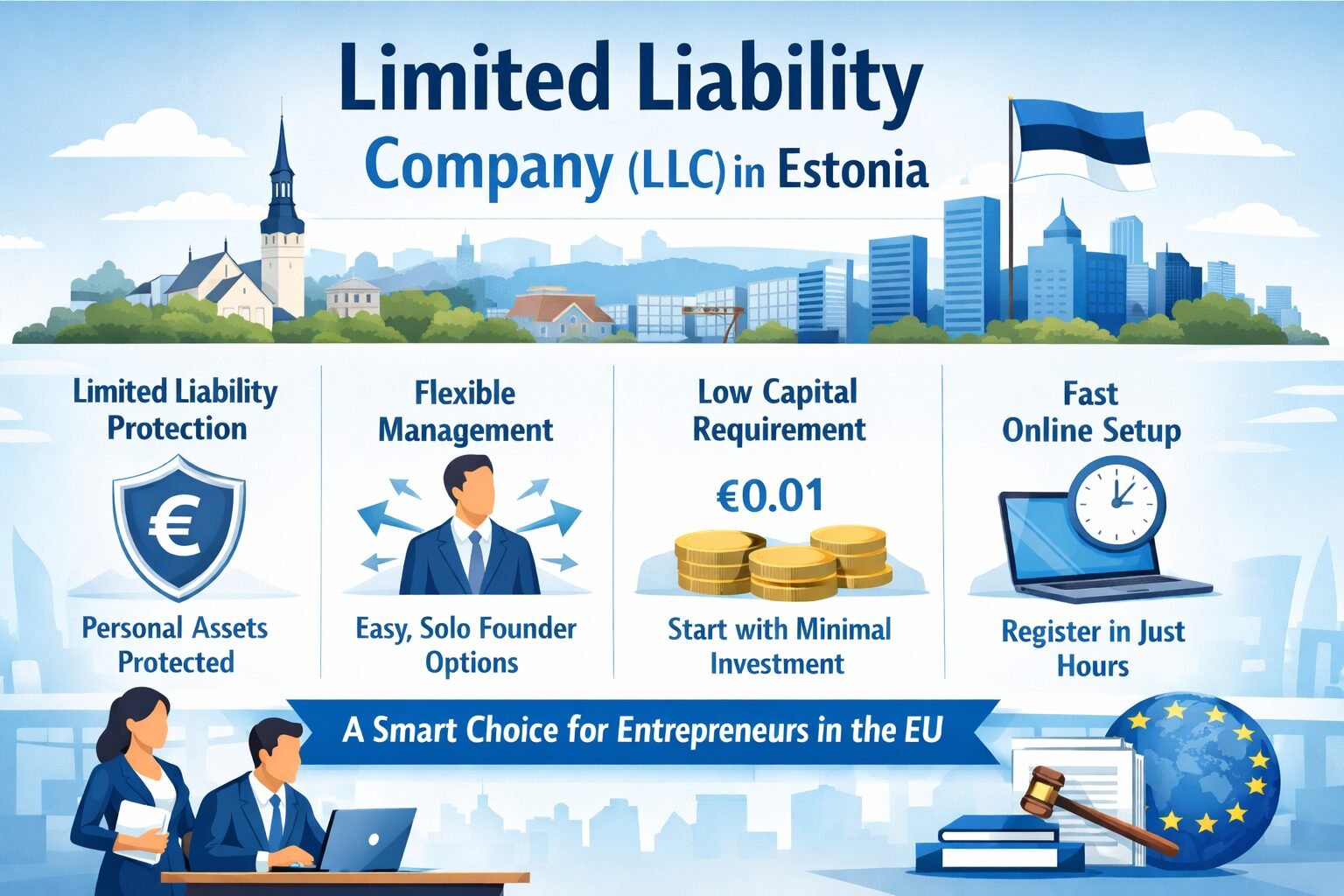
One of the most important characteristics of an LLC in Estonia is the principle of limited liability. Shareholders are generally responsible for the company’s obligations only up to the value of their share capital contribution.
This means that personal assets such as savings, real estate or other private property are normally protected from business liabilities. The company itself is responsible for its debts and legal obligations.
- The company is a separate legal entity.
- Shareholder liability is limited to invested capital.
- Personal assets are generally protected from business risks.
This legal separation between the company and its owners is one of the main reasons why entrepreneurs prefer operating through an Estonian limited liability company rather than as sole proprietors.
Management Structure of an LLC in Estonia
The governance structure of an Estonian OÜ is intentionally simple and flexible. Every company must have a management board responsible for daily operations, but the board can consist of only one member.
This allows a single person to operate the company independently while maintaining full legal compliance.
- One shareholder is sufficient to establish an OÜ.
- The management board may consist of a single person.
- The same person can act as shareholder and board member.
This flexible governance model makes the Estonian limited liability company particularly attractive for startups and small businesses that want to maintain simple decision-making structures.
Foreign entrepreneurs are also allowed to own 100% of an LLC in Estonia. When the management board is located outside Estonia, a local contact person may be required for official communication with authorities.
Share Capital Requirements
Estonia has one of the most flexible capital frameworks in Europe for establishing a limited liability company.
Today, the minimum share capital for an OÜ may start from as little as €0.01. This allows entrepreneurs to launch a company without significant upfront capital commitments.
- Minimum share capital starting from €0.01.
- No significant upfront investment required.
- Flexible capital contribution options for founders.
This approach makes Estonia one of the most accessible jurisdictions in Europe for establishing a limited liability company, particularly for early-stage startups and small businesses.
Compared with some jurisdictions such as Germany, where a standard GmbH requires €25,000 in share capital, the Estonian model provides a much lower entry barrier for entrepreneurs.
LLC in Estonia Compared to Other Company Types
The Estonian OÜ is comparable to several limited liability company structures used internationally.
- Estonia — OÜ (private limited company)
- United States — LLC
- United Kingdom — Ltd
- Germany — GmbH
Although the legal terminology differs, these company structures share the same core principles: limited liability protection, a separate legal entity and defined ownership through shares.
The Estonian limited liability company stands out because of its efficient digital administration and relatively simple regulatory framework.
Final Thoughts
The limited liability company in Estonia, known as the OÜ, offers a reliable and flexible corporate structure for entrepreneurs who want to operate within the European Union. With limited liability protection, simple governance rules and flexible capital requirements, the Estonian OÜ provides a practical foundation for building and developing a business.
For many founders, understanding how an LLC in Estonia works is the first step toward establishing a modern European company structure. If you are planning to set up an Estonian OÜ, you can learn more about the process on our page about company formation in Estonia.
Eesti Firma assists international entrepreneurs with understanding the Estonian corporate framework and supports businesses in establishing and managing their companies in full compliance with local legal requirements.
FAQ | Frequently Asked Questions
Below are answers to commonly asked questions about starting, managing, and operating a business, based on typical inquiries received by our specialists.
- What are the key features of a Limited Liability Company in Estonia?
A Limited Liability Company in Estonia (OÜ) combines share-based ownership, limited liability protection, flexible management, and minimal share capital requirements, making it the most practical company structure for entrepreneurs.
- How is a Limited Liability Company in Estonia structured?
A Limited Liability Company in Estonia is structured with shareholders who own shares and a management board responsible for daily operations, while the company itself operates as a separate entity.
- How is management organized in an Estonian LLC?
Management is carried out by a management board, which can consist of a single member, allowing simplified decision-making and operational flexibility.
- Can one person establish and run a Limited Liability Company in Estonia?
Yes. One individual can act as both shareholder and management board member, enabling full control of the company within a simple governance structure.
- What makes the Estonian LLC flexible for entrepreneurs?
The Estonian LLC offers flexibility through simple governance rules, возможность единоличного управления, and adaptable capital structure.
- What are the share capital requirements for an LLC in Estonia?
The share capital for a Limited Liability Company in Estonia can start from €0.01, allowing entrepreneurs to establish a company without significant upfront investment.
- How does an Estonian LLC compare structurally to companies in other countries?
Structurally, an Estonian LLC is similar to an LLC in the United States, a Ltd in the UK, or a GmbH in Germany, sharing features such as limited liability and defined ownership through shares.
Note: The FAQ is provided for general informational purposes only and does not constitute legal, tax, or financial advice. Requirements and procedures may vary depending on jurisdiction, business model, and individual circumstances.