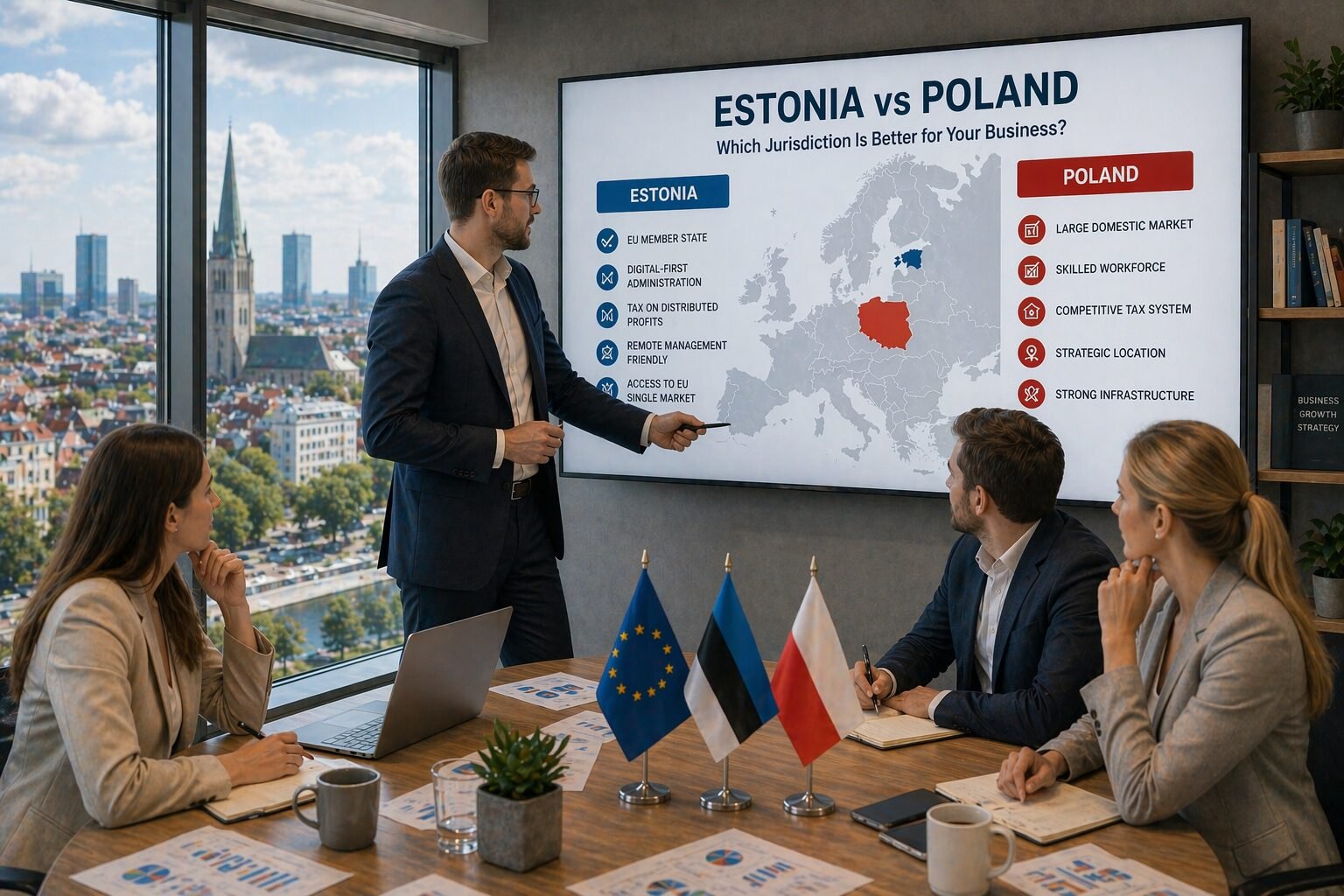
Choosing between Estonia and Poland is not just about where it is easier to register a company. For non-resident founders, the more important question is which jurisdiction better supports the real business model behind the company. That usually means looking at remote administration, taxation, market access, hiring plans, operating complexity, and long-term scalability.
Both countries can work well, but they solve different business problems. Poland is often stronger when the business needs a larger domestic market, local hiring, warehousing, logistics, or a stronger physical presence. Estonia is often stronger for lean international structures, digital businesses, service-based companies, and founders who want an EU company that can be managed with less friction from abroad.
If you are considering starting a company in Europe, it makes sense to compare these two jurisdictions through the lens of how the company will actually operate after registration, not just how quickly it can be incorporated.
Estonia vs Poland at a Glance
At a high level, Estonia is usually the more practical choice for remote-first and internationally oriented founders, while Poland is often the more natural choice for businesses built around the Polish market, local teams, or physical operations.
This comparison is intentionally practical rather than overly technical. The key issue is not which country sounds better in theory, but which one fits the way the company will actually work in practice.
Why Estonia Is Often the Better Fit for Remote-First Founders
For many international founders, Estonia’s strongest advantage is not simply that it is possible to register a company there. The deeper advantage is that Estonia often feels more natural for a remotely managed business. This matters most when the company serves international clients, sells services across borders, or is built around a founder who does not need a large local market from day one.
A common mistake is to choose a jurisdiction based mainly on market size, even when the business model does not actually need that market at the early stage. For a service company, a SaaS project, a consulting practice, or an agency, founder convenience and administrative efficiency often matter more in year one than the size of the domestic economy.
Digital-first administration
Estonia is widely associated with digital company management, and that matters long after incorporation. Registration is only the starting point. The real question is how easy it will be to handle filings, accounting coordination, corporate documentation, and routine administration over time. For many non-resident founders, Estonia offers a cleaner and more predictable environment for that kind of ongoing management.
Stronger fit for international and cross-border structures
Estonia is often a better match when the company is meant to operate internationally rather than build around one local customer base. This is especially relevant for consultants, agencies, software businesses, online service providers, and founders who want an EU company that can support cross-border operations with less friction.
Attractive logic for retained and reinvested profit
Another reason Estonia stands out is the corporate tax model. Retained and reinvested profits are generally not taxed in the same way as in more conventional systems, which makes Estonia especially appealing for founders who plan to grow the business before taking profits out. For companies focused on scaling, this can be more important than a headline tax comparison.
Better suited to lean operational models
A large domestic market is only an advantage if the business is actually designed to use it. Many foreign founders do not need local warehousing, large local teams, or country-specific infrastructure at the incorporation stage. In such cases, Estonia often feels more proportionate to the real size and shape of the business.
Why Poland Can Be the Better Fit for Local-Market and Operational Businesses
Poland has different strengths, and they should be taken seriously. If the business is meant to be built around the Polish market itself, Poland can be the more logical choice. This is particularly true when the company needs local staff, physical presence, local customers, domestic logistics, or a broader operating base inside one large economy.
That is why Poland can make more sense for certain retail, warehousing, distribution, staffing, and on-the-ground service models. In these cases, the size of the market is not just a marketing point. It becomes part of the company’s real commercial logic.
Better fit for businesses focused on Poland itself
If the founder already knows that Poland will be the main market, then Poland may offer a more natural commercial base. This applies especially where sales, suppliers, local contracts, or operational decision-making are centered there.
More relevant for local hiring and physical operations
Businesses that depend on employees, warehouses, fulfillment, or a stronger physical footprint often benefit more from being incorporated where those activities are concentrated. In that kind of structure, operational convenience may matter more than digital elegance.
Stronger case when market size is commercially central
Some founders overestimate the value of a larger market. Others genuinely need it. If the business model depends on accessing a larger domestic economy from the start, Poland may be the better answer. The point is to match the jurisdiction to the actual revenue logic of the company.
Comparing the Most Popular Company Types
A useful Estonia-versus-Poland comparison should focus on the main limited liability forms, because that is usually the real decision for foreign founders.
OÜ in Estonia
For most non-resident founders looking at Estonia, the practical company form to compare is the OÜ. It is the standard private limited company format and is usually the most relevant structure for consulting businesses, digital services, SaaS, agencies, international trade, and other scalable founder-led models.
The OÜ is often attractive because it combines limited liability, flexibility, and a business environment that feels especially compatible with remote management. That is one reason why many founders exploring company formation in Estonia see the OÜ not just as a legal form, but as a practical operating structure for international business.
sp. z o.o. in Poland
In Poland, the most comparable structure is the sp. z o.o. For founders who need a conventional Polish operating company, this is usually the main format to analyse. It often makes the most sense where the company is expected to work inside the Polish market, hire locally, or build a more traditional operating presence.
Why this is the main comparison
For most foreign founders, the real question is not which country offers more legal forms on paper. It is which limited liability structure better supports a credible, scalable, and workable business. That is why OÜ versus sp. z o.o. is the most useful practical comparison.
What about sole proprietorships?
Sole proprietor routes exist in both countries, but they are usually less relevant in this context. For a non-resident founder building a serious cross-border company, the more important comparison is between the main limited liability structures, not the lightest solo-business format.
Tax Logic and Founder Strategy
Tax should never be viewed in isolation, but it should not be ignored either. Founders often make the mistake of comparing headline rates without thinking about how the company will actually use profit.
Estonia is often better when profit stays in the company longer
If the founder expects to reinvest profit into growth rather than distribute it early, Estonia is often more attractive. In practice, this makes the jurisdiction especially relevant for businesses that want to build first and extract value later.
Poland follows a more conventional corporate tax logic
Poland is usually easier to understand through the lens of a standard corporate tax environment. That may feel more familiar to some founders, especially where the business is already designed around a more traditional operational setup.
The better question is how the business will use profit
A founder should not choose a country based only on a tax slogan. The more useful question is whether the company will reinvest earnings, distribute them early, build operational depth locally, or stay lean and internationally focused.
Estonia vs Poland for Different Business Models
The clearest way to choose between Estonia and Poland is to compare both countries against the actual business model rather than against abstract ideas about what sounds prestigious or tax-efficient.
SaaS, software, consulting, and agencies
Estonia is often the cleaner fit for digital and service-based business models. These companies usually benefit more from remote administration, simplicity, and a structure that works well across borders than from a large domestic market.
E-commerce and cross-border trade
This depends on how the business is built. Estonia can be an efficient legal base for a remotely managed cross-border structure. Poland may be stronger if warehousing, fulfillment, local logistics, or significant domestic sales are central to the model.
Retail, logistics, and hiring-heavy operations
Poland is often the better fit when the company depends on physical infrastructure, local teams, or a strong operating presence in one market.
Founder-owned international structures
Estonia is often more attractive for international founder-owned companies that need flexibility, a credible EU presence, and a relatively efficient administrative framework rather than a large domestic operating base.
Choose Estonia If…
Estonia is often the stronger choice if:
- you want to manage the company remotely;
- you serve international clients rather than one local market;
- you run a consulting, SaaS, IT, agency, or service-based business;
- you want an EU company with a leaner administrative feel;
- you plan to retain and reinvest profit for growth;
- you do not need local warehousing, large local teams, or a heavy physical footprint from day one.
For many founders, Estonia is appealing not because it promises anything magical, but because it often gives the right balance of flexibility, credibility, digital administration, and long-term practicality.
Choose Poland If…
Poland is often the stronger choice if:
- your main target market is Poland itself;
- you need local employees and local operating infrastructure;
- your model depends on warehousing, logistics, or domestic distribution;
- you are building a more traditional operational business rather than a lean international structure;
- the size of the local market is commercially central to your revenue model.
In these situations, Poland may be more practical because the company is built around the country’s local operating strengths rather than around remote administrative efficiency.
Final Verdict: Estonia or Poland?
Poland can be the better choice for founders building around the Polish domestic market, local teams, warehousing, logistics, or physical operations. Estonia is often the better choice for non-resident founders who want a flexible, remotely manageable EU company for digital, international, and lean business models.
The right answer depends on what the company is actually meant to do after incorporation. If the business is built around Poland, Poland may be the better operating base. If the business is designed for cross-border services, digital activity, remote administration, and long-term flexibility, Estonia will often be the more efficient and founder-friendly option.
If that profile fits your plans, it may make sense to explore how to register a company in Estonia in a way that matches your business model and long-term goals.
FAQ | Frequently Asked Questions
Below are answers to commonly asked questions about starting, managing, and operating a business, based on typical inquiries received by our specialists.
- Is Estonia or Poland better for a remote-first business?
Estonia is often the better choice for a remote-first business because it is usually more practical for founders who want to manage a company digitally and work with clients across borders. Poland can also work, but it is often more suitable when the business has stronger local operational needs.
- Is Poland better than Estonia for local hiring, warehousing, and physical operations?
In many cases, yes. Poland is often the more practical option when the business depends on local employees, warehousing, logistics, distribution, or direct activity in the Polish market. Estonia is usually stronger for leaner structures that do not depend on a heavy physical presence.
- What is more suitable for foreign founders: an Estonian OÜ or a Polish sp. z o.o.?
That depends on how the business will operate. An Estonian OÜ is often more suitable for foreign founders who want a flexible EU company for international services, digital business, or remote management. A Polish sp. z o.o. is often more suitable when the company is meant to operate mainly in Poland.
- Does Poland’s larger market always make it the better country for company formation?
Not necessarily. A larger market is only a real advantage if the business is built to use it from the start. For many consultants, SaaS founders, agencies, and international service providers, remote administration and structural efficiency may matter more than domestic market size in the early stage.
- Is Estonia usually better for SaaS, consulting, and cross-border service businesses?
In many cases, yes. Estonia is often the better fit for SaaS, consulting, agency, and cross-border service businesses because these models usually benefit more from remote administration, simplicity, and international flexibility than from local-market scale. Poland may be more practical only if the business is strongly tied to operations in Poland.
- When does Poland make more sense than Estonia for non-resident founders?
Poland often makes more sense when a non-resident founder is building around the Polish market itself, plans to hire locally, needs logistics or warehousing, or expects the company to have a stronger physical presence there. Estonia is usually more attractive when the founder wants a leaner and more internationally oriented structure.
Note: The FAQ is provided for general informational purposes only and does not constitute legal, tax, or financial advice. Requirements and procedures may vary depending on jurisdiction, business model, and individual circumstances.