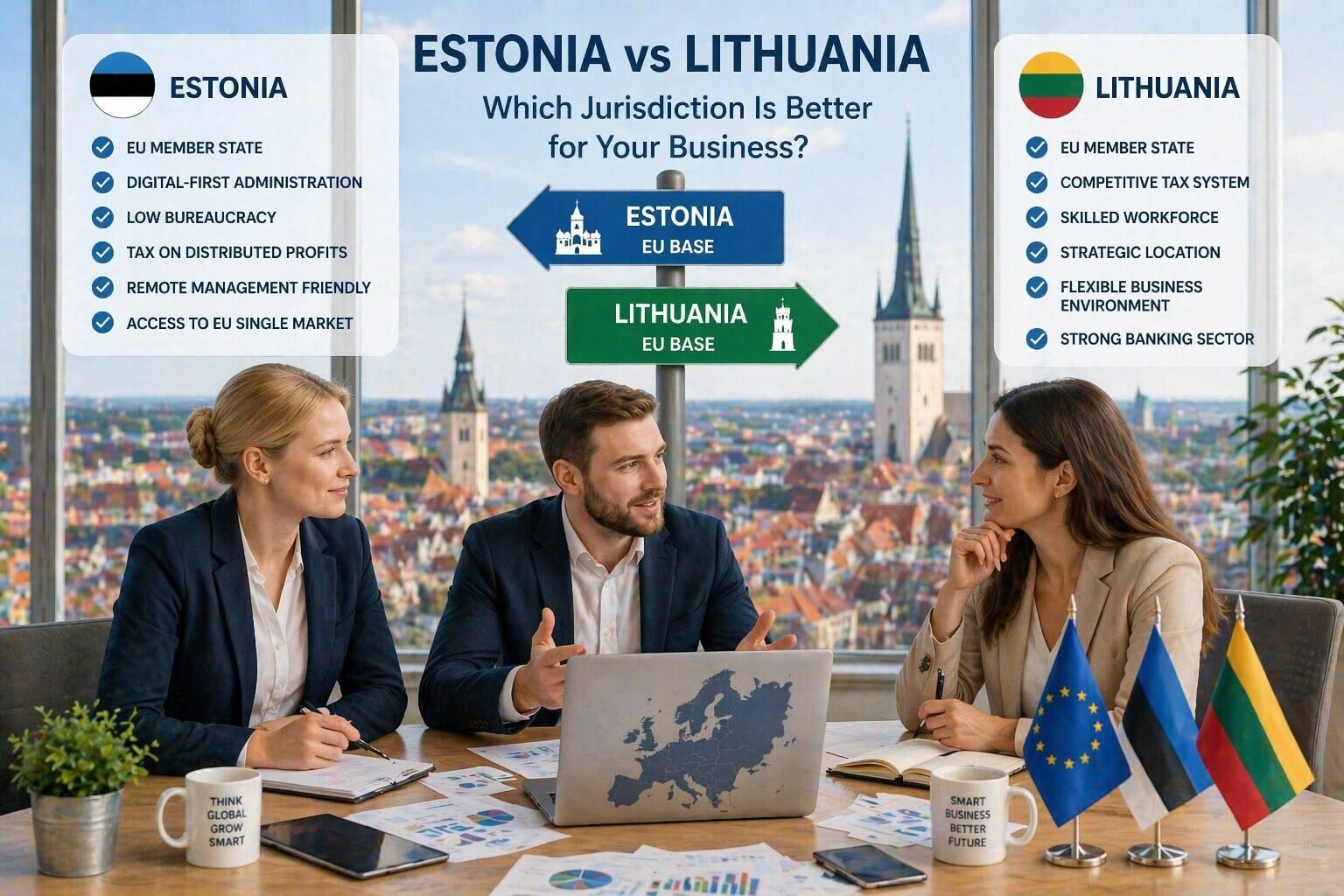
Choosing between Estonia and Lithuania for European company formation is not only about where it is easier to register a business. For most founders, the more important question is which jurisdiction better supports the actual business model behind the company. That usually means looking at remote administration, company structure, tax logic, operational flexibility, long-term scalability, and how practical the jurisdiction is for cross-border activity.
Both Estonia and Lithuania are credible European Union jurisdictions. Both can work well for foreign founders. However, they do not suit every entrepreneur in exactly the same way. In practice, Estonia is often the stronger option for founders who want a digital-first company that can be managed efficiently from abroad, while Lithuania may appeal more in cases where the founder prefers a more conventional operating setup or has stronger local-business reasons to structure there.
If you are already considering company formation in Estonia or exploring company registration in Lithuania, this comparison can help you understand which jurisdiction may be the better fit before making a final decision.
Why Founders Compare Estonia and Lithuania
Estonia and Lithuania are often compared because both are practical EU jurisdictions for international entrepreneurs. Both provide access to the European market, both can support cross-border business, and both are relevant to founders who want an EU company rather than a structure outside the European Union.
At the same time, the choice is rarely just legal or administrative. It is usually strategic. Some founders want to build a remote-first SaaS or consulting company. Others want a trading, e-commerce, or operational structure with stronger regional substance. Some care most about digital administration and long-term efficiency. Others prefer a more conventional business environment or a structure that feels closer to traditional operating models.
That is why the real question is not simply which country is better in general, but which country is better for a specific founder profile and business model. This wider decision logic also connects with the broader topic of starting a company in Europe and the more general comparison of the best place to set up a company.
Comparison Table: Estonia vs Lithuania for Company Setup
Before choosing between Estonia and Lithuania, it is useful to compare the two jurisdictions from a practical business perspective. The table below highlights the main differences in company type, administrative logic, remote usability, and overall suitability for non-resident founders.
This table is intentionally practical rather than overly technical. Neither jurisdiction is universally better in every case. The right choice depends on what kind of company you are building, how it will be managed, and where the business will actually operate.
The Most Popular Company Types: OÜ vs UAB and MB
When founders compare Estonia and Lithuania, they should not compare only countries. They should also compare the company forms they are most likely to use in practice. In most real cases, that means comparing the Estonian OÜ with the Lithuanian UAB, while also understanding where the Lithuanian MB may be relevant.
This is important because the most popular company type in each jurisdiction usually tells you a great deal about how the business environment functions and which structure is considered normal for scalable commercial activity.
Why the OÜ is the standard choice in Estonia
The OÜ is the default company type for most founders in Estonia. It is widely used for service businesses, digital companies, consulting firms, holding structures, and cross-border commercial activity. This matters because it shows that the structure is not niche or unusual. It is the normal and scalable vehicle for a broad range of real businesses.
From a strategic point of view, the strength of the OÜ is not only in limited liability. It is also in how naturally the structure fits Estonia’s broader digital business environment and remote administration logic.
Why the UAB is the standard option in Lithuania
In Lithuania, the UAB is generally the most common and most practical limited liability structure for standard business activity. It is usually the form that international founders compare directly with the Estonian OÜ.
The UAB can appeal to founders who want a familiar corporate format for operational business inside the EU. It is credible and commercially usable, but the key question is whether it works better than an OÜ for the actual business model behind the company.
Where the Lithuanian MB may be relevant
The Lithuanian MB may be attractive in some smaller founder-led scenarios. However, for most international entrepreneurs comparing Estonia and Lithuania as scalable European company bases, the central comparison is still OÜ versus UAB rather than OÜ versus MB. For most decision-making purposes, that is the comparison that matters most.
Remote Administration and Cross-Border Usability
For many founders, this is where the difference becomes more visible. It is one thing to register a company. It is another thing to manage it efficiently over time, especially if the founder is a non-resident and does not intend to relocate physically.
Estonia for digital-first and remote founders
Estonia is often chosen by founders who want a company that can function as an EU business base without excessive administrative friction. This is one of the main reasons why Estonia is frequently associated with digital entrepreneurship, international services, and remote company management.
For many international entrepreneurs, the appeal is not only the company registration itself, but the ability to manage core corporate matters more efficiently over time. That is why many founders looking for a modern EU structure begin by exploring registering a company in Estonia.
Lithuania for founders with a more conventional operating focus
Lithuania can still be attractive where the founder is less focused on a digital-first administrative philosophy and more interested in a practical operating company within the EU. In some scenarios, this may suit trading businesses, regional activity, or founders who simply prefer a more conventional business environment.
For that reason, some entrepreneurs may still decide that starting a company in Lithuania is the better route for their specific structure.
Tax Logic and Business Model Fit
A jurisdiction should not be chosen only because of a headline tax phrase. The real issue is whether the tax logic fits the business model. A founder who plans to reinvest profits, grow gradually, and build a scalable structure may view the decision differently from a founder who expects a more traditional operating pattern from the beginning.
When Estonia may be stronger
Estonia is often attractive to founders who think in terms of long-term scaling, retained earnings, and operational flexibility. In many modern business models, especially digital services, SaaS, consulting, and holding-style structures, the ability to build the company in a lean and reinvestment-oriented way matters more than superficial comparisons.
That is one reason Estonia often appears in wider discussions about the best country to start your business.
When Lithuania may still suit the business better
Lithuania may make sense where the founder expects a more conventional operating company from the beginning, especially if the structure is meant to interact more directly with local or regional execution patterns. In that kind of case, the UAB can be a practical and credible vehicle. The right answer depends less on general reputation and more on how the business will actually function day to day.
Which Jurisdiction Fits Different Founder Scenarios
Rather than asking which country is universally better, it is usually more useful to ask which one fits a specific founder profile and business model.
For SaaS and online service businesses
Estonia is often the stronger option for SaaS companies, remote agencies, online consulting businesses, and digital service providers. These companies usually need a clean and efficient EU structure, but they do not always need heavy local substance from day one. In that context, Estonia often feels more aligned with how the business actually works.
For e-commerce and trading companies
This category is more case-specific. Estonia can work very well, especially where the business is run cross-border and centrally managed. Lithuania may be attractive in situations where the operating logic is more regionally grounded or the founder prefers a jurisdiction that feels more conventional from an operational perspective.
For consulting and agency models
Consulting businesses, agencies, and professional services firms often benefit from Estonia when the founders want a remote-friendly EU company that can support international invoicing and cross-border commercial credibility. These are exactly the types of companies that often start by reviewing company formation in Estonia as a practical base for long-term European operations.
For founder-led regional structures
Lithuania may be suitable where the company is more closely tied to regional operating activity, local execution, or a founder’s preference for a more traditional structure. In those cases, company registration in Lithuania may be the more rational direction.
Which Is Better for Non-Resident Founders?
This is one of the most common real-world questions. Both jurisdictions can be relevant to foreign founders, but they do not feel the same in practice.
Estonia is often better for non-resident founders who want a digital-first EU company, efficient remote administration, and a structure that supports cross-border services or online business. Lithuania may still be the better choice where the founder has stronger local or regional reasons to be there, or where the business model is more traditional in operating style.
For that reason, the better choice depends on how the company will actually be run, not only on where it is incorporated on paper.
Final Verdict: Estonia or Lithuania?
Estonia and Lithuania are both viable European jurisdictions for company formation. Both can support real business. But they usually do not serve exactly the same strategic purpose.
For many non-resident entrepreneurs, Estonia is often the stronger choice because the OÜ structure, the digital administrative environment, and the broader logic of remote company management fit modern European business models especially well. This is particularly true for SaaS, consulting, online services, and other businesses that want an EU company without unnecessary friction.
Lithuania remains a credible option in some cases, especially where the founder prefers a more conventional operating setup or has stronger practical reasons to base the structure there. The best decision is not ideological. It is structural.
If your goal is to build a flexible, credible, and scalable EU company for international activity, Estonia will often be the more compelling answer. If you are comparing European jurisdictions more broadly before choosing one country, it also makes sense to explore starting a company in Europe and the wider discussion around where is the best country to start your business.
FAQ | Frequently Asked Questions
Below are answers to commonly asked questions about starting, managing, and operating a business, based on typical inquiries received by our specialists.
- Is Estonia or Lithuania better for non-resident founders?
For many non-resident founders, Estonia is often the stronger choice because it is especially well known for digital administration, remote company management, and structures that work well for cross-border business. Lithuania can still be a good option in some cases, especially where the founder has stronger regional or operational reasons to base the company there.
- What is the difference between an Estonian OÜ and a Lithuanian UAB?
An Estonian OÜ and a Lithuanian UAB are both limited liability company structures, but they are often used in slightly different business contexts. The OÜ is frequently chosen for digital, service-based, and remotely managed EU businesses, while the UAB is often seen as a more conventional operating structure for broader commercial activity in Lithuania.
- Is Estonia better than Lithuania for online businesses and SaaS companies?
Estonia is often better suited to online businesses, SaaS companies, consultants, and other digital-first business models because it is closely associated with efficient remote administration and a business environment that works well for international founders. Lithuania can still work, but Estonia is often more aligned with businesses that do not depend on heavy local operational presence.
- Which country is better for a traditional operating business: Estonia or Lithuania?
Lithuania may be more attractive for some traditional operating businesses, especially where the company is more closely connected to regional execution, local commercial relationships, or a more conventional business structure. Estonia is often stronger where the company is meant to be flexible, scalable, and easier to manage across borders.
- Do Estonia and Lithuania both provide access to the EU market?
Yes, both Estonia and Lithuania are EU member states, so both can provide a European legal base and access to the EU market. The real difference is usually not EU access itself, but how the jurisdiction fits the company’s structure, administration style, and long-term business goals.
- How should founders choose between Estonia and Lithuania for company formation?
Founders should choose between Estonia and Lithuania based on the actual business model, not only on country image or headline tax comparisons. The most important factors usually include the type of company needed, the level of remote administration required, where the business will operate, whether the structure must support cross-border growth, and which jurisdiction feels more practical for long-term use.
Note: The FAQ is provided for general informational purposes only and does not constitute legal, tax, or financial advice. Requirements and procedures may vary depending on jurisdiction, business model, and individual circumstances.