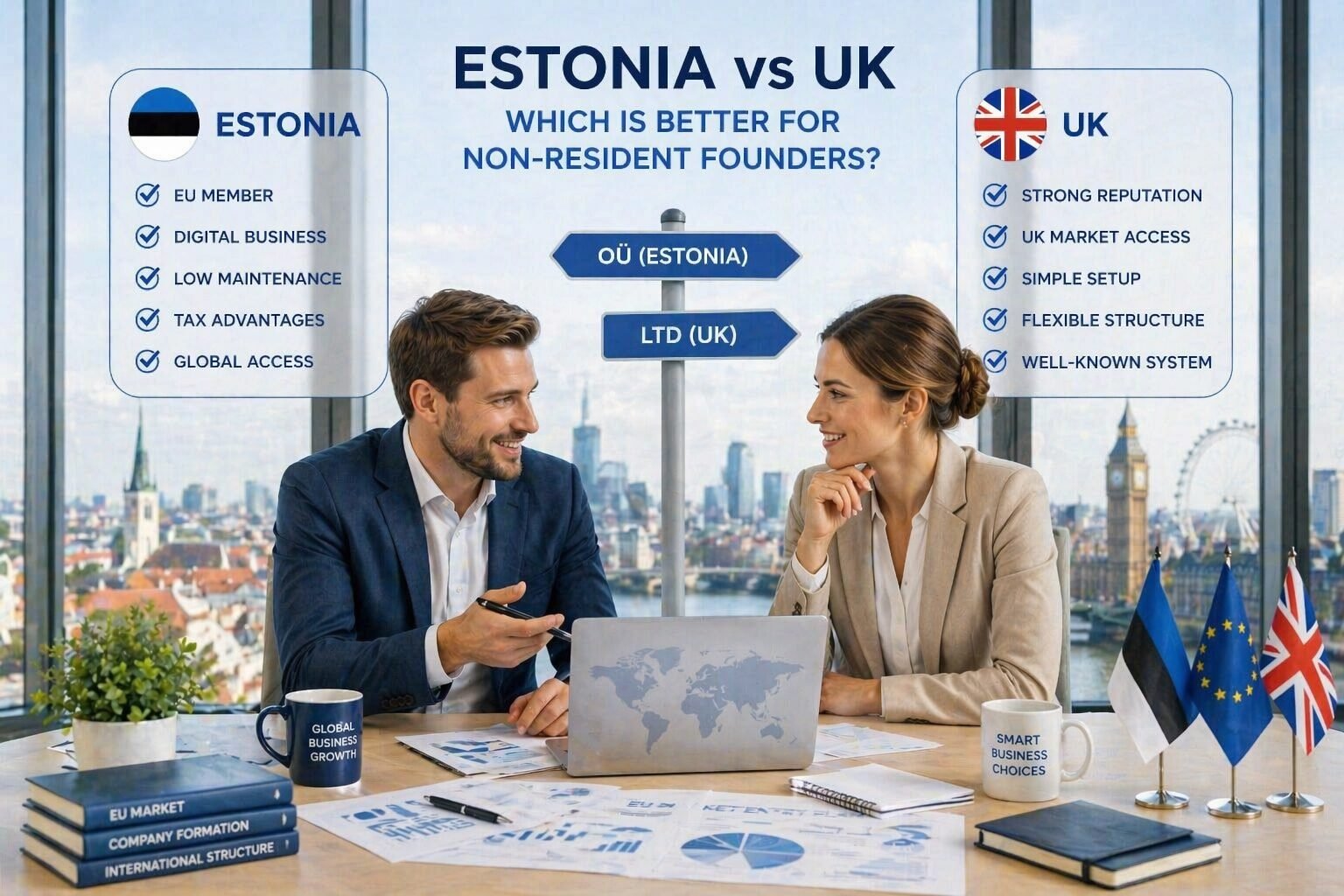
Most founders who compare Estonia vs UK company formation are really comparing two specific corporate forms: the Estonian private limited company, the OÜ, and the UK private company limited by shares, the Ltd. Both are open to foreign owners, both can be registered in about a day, and both are easy to explain to a client. The practical question is narrower: do you want an EU company you can administer from anywhere and tax only when profit leaves it, or a company that sits inside the British market?
An Estonian OÜ is built for the first case. It can be founded, signed for, invoiced from and reported online, inside the EU, by someone who never sets foot in Tallinn — and it pays no corporate income tax at all on profit it keeps in the business. A UK Ltd is built for the second: it assumes a centre of gravity in Britain, with UK clients, UK contracts, UK banking, and an annual Corporation Tax charge on profit as it is earned.
What follows is a decision framework for anyone choosing where to register a company as a non-resident: an Estonian company against a UK limited company, and the cost of using one for the other’s job.
For founders who primarily need a European structure rather than a British presence, starting a company in Europe is worth understanding in practice before committing.
For most founders who reach this page — non-resident, digital, selling across Europe or internationally — company formation in Estonia is the more practical route: an EU company registered online, managed remotely, with 0% tax on profit you reinvest and an EU VAT number from the start. A UK Ltd earns its place in a narrower case: when your customers, contracts and commercial identity are genuinely British. Outside that case it gives you Corporation Tax of up to 25% on profit you have not taken out, a non-EU entity for an EU-facing business, and a banking problem non-resident owners discover only after incorporation.
Anyone choosing between a UK limited company and an Estonian OÜ from outside both countries: software and IT businesses, consultants and agencies, online sellers, e-residents, and owners whose clients are scattered across several markets rather than concentrated in one.
Estonian OÜ vs UK Ltd: The Short Version
Six points carry most of the decision between an Estonian OÜ and a UK Ltd. The rest of this guide unpacks them.
- •An Estonian company is taxed when profit leaves it. A UK Ltd is taxed on profit when it is earned. That single difference drives most of the decision.
- •An Estonian OÜ pays 0% on retained profit and corporate income tax only on distribution — 22/78 of the net dividend, about 22% of the gross, paid by the company. It is registered online, from €0.01 of share capital, with no residency requirement for owners or the management board.
- •UK Corporation Tax runs at 19% on profits up to £50,000 and 25% above £250,000, with an effective marginal rate of 26.5% in between — payable whether or not you distribute anything.
- •The UK does not withhold tax on dividends paid to non-resident shareholders, which is a point in the Ltd’s favour — though it applies to profit the company has already been taxed on at up to 25%.
- •Estonia is in the EU, the single market and the customs union; the UK is outside all three. For a business selling into Europe that is a VAT, customs and paperwork question — not a matter of reputation.
- •Neither jurisdiction removes your home-country tax. Where you are tax-resident still matters, whichever company you register.
Estonia vs the UK: Two Different Problems
Estonia and the UK solve different problems for a founder, and the comparison only makes sense once that is on the table.
Estonia is an administrative base. Founders register an Estonian company because they need a European legal entity that can be incorporated, signed for, invoiced from and reported online — inside the EU, without tying up capital, and without building the business around any single national market. The jurisdiction is deliberately designed around companies whose owners live somewhere else.
The UK is a market. Its appeal is not the registry but everything attached to it: a domestic market of close to 70 million people, a deep professional services layer, English common law, London finance, and a company form every British client and procurement department recognises without explanation. A Ltd is what you build when you want to trade inside Britain.
The confusion starts when a founder uses one for the other’s job: setting up a UK limited company for a purely EU-facing online business that will never have a British customer, or expecting an Estonian OÜ to serve as a British high-street presence. Both are avoidable errors once the split is clear.
When Estonia Is the Right Answer
An Estonian company comes into its own when a founder wants to keep the company’s jurisdiction separate from their own location and from any single market. The business may sell software to clients in eight countries, consult across the EU, run an agency with a distributed team, or operate an online platform with no physical footprint anywhere.
For that profile, a Ltd’s annual Corporation Tax on undistributed profit, its non-EU status and its banking friction for non-resident owners are costs with no commercial return. That is the case the Estonian OÜ was shaped around: minimal share capital, online registration, remote management through e-Residency or a power of attorney, EU status by default, and no corporate income tax on profit that stays in the company.
When the UK Is the Right Answer
A Ltd makes sense when the business is anchored in Britain: your customers are in the UK, your contracts are governed by English law, you sell to UK corporates or public bodies that expect a domestic counterparty, you employ people in Britain, or your positioning depends on being visibly UK-based.
In those cases the UK’s costs are not overhead — they are the price of being where the business is. English contract law, a familiar corporate form and a mature payments market have real commercial value, and an Estonian OÜ does not substitute for them.
Comparison Table: Estonia vs UK Company Formation
Estonia vs UK company formation, set side by side on the points that decide the matter: tax, registration, EU status and what each company owes its registry every year. Rates, fees and thresholds change with legislation in both countries, so check the position that applies on the day you incorporate.
Estonia sells a low-friction EU base and charges only when profit leaves the company. The UK sells access to the British market and English law, and charges for it with an annual tax on profit you have not touched. One is an operating base; the other is a market entity — the costly mistake is buying one when you needed the other.
There is no such thing as a “UK LLC” — the LLC is a United States form. The British limited-liability vehicle for trading businesses is the private company limited by shares, the Ltd; the LLP, or limited liability partnership, is a separate corporate body taxed as a partnership and used mainly by professional firms. Its Estonian counterpart is the OÜ, or osaühing. If you are comparing an LLC with an Estonian company, you are comparing across the Atlantic rather than across the North Sea, and the analysis is a different one.
Where the Estonian OÜ Pulls Ahead of a UK Ltd
Side by side on a registration form, the OÜ and the Ltd are hard to tell apart. Four differences in what surrounds that form decide which one a founder abroad can live with.
Identity verification, the PSC register and Estonia’s Business Register
Neither country requires a local director; what differs is everything built around that. A UK company must put its directors and its people with significant control through Companies House identity verification and list them on the public PSC register. An Estonian company is public about its owners too — shareholders and board members appear on the Business Register — but there is no separate verification layer to clear before it can trade. Where no board member is an EU or EEA resident, what it needs instead is an Estonian legal address and contact person: a service arrangement rather than a gate.
Remote formation: e-Residency or a UK registered office
A UK Ltd is filed online at Companies House, and an Estonian OÜ is filed online through the Business Register — but the Estonian route was designed for owners who are somewhere else. A founder who cannot travel signs through e-Residency or a notarised power of attorney, and the same digital channel carries the filings, tax returns and annual report afterwards. The UK equivalent assumes correspondence to a physical “appropriate address” in Britain that reliably receives post, which is where a non-resident owner starts paying for a proxy presence.
An EU VAT number, or invoicing as a third country
This is where the EU line on the map turns into paperwork. An Estonian OÜ trades inside the single market and holds an EU VAT number. A UK Ltd reaches the same European customers from outside it, as a third country, which turns ordinary sales into an extra layer of registrations and declarations — set out in detail further down. Both companies can serve the same clients; only one of them does it without a customs border in the middle.
The first year: 0% on retained profit, or Corporation Tax on it
Formation costs little in both jurisdictions; the divergence starts twelve months later. An Estonian company that earns and reinvests pays no corporate income tax at all, files its annual report and carries on — share capital from €0.01 per shareholder, still untouched. A UK Ltd in the same position files accounts and a CT600 and pays Corporation Tax on money that never left the business. For a founder building rather than extracting, that is the whole argument.
The UK Limited Company: What It Costs to Set Up and Run
The Ltd is the standard British trading vehicle, and it is what UK clients, suppliers, banks and procurement teams expect to see. It is incorporated at Companies House, the United Kingdom’s company registry, usually within a day and for a modest filing fee, with no minimum capital in practice and no requirement for a UK-resident director. On paper it is one of the most accessible company forms in Europe.
The obligations sit in what follows. The company must maintain an “appropriate address” as its registered office in the UK, where post is reliably received; a PO box will not do. It must file annual accounts at Companies House and a Corporation Tax return, the CT600, with HMRC. It must file a confirmation statement at least once every twelve months, keeping the register of directors and the register of people with significant control up to date. Under the Economic Crime and Corporate Transparency Act, directors and people with significant control are subject to identity verification, so a UK company cannot be held at arm’s length from the people behind it.
Then there is the practical bottleneck. Corporation Tax falls due nine months and one day after the end of the accounting period, on profit as earned, before you have decided whether to keep it in the business. Accounts must be filed even if the company is dormant. The PSC register is public. And UK high-street banks generally expect a UK-resident director or a working UK presence, while the fintech providers non-residents fall back on apply their own restrictions to UK companies with no British footprint.
A UK Ltd is often sold to non-residents as a cheap, fast, prestigious company — and the first two are true. What is rarely mentioned is that Corporation Tax at up to 25% falls on profit whether or not you take it out, that beneficial ownership is published, and that a UK company with no British substance is hard to bank. Registration is the easy part; the account is not.
Tax Logic: Deferral in Estonia, Annual Taxation in the UK
Everything above shapes the decision. This is the part that changes what the company keeps.
How Much Tax Does an Estonian Company Pay?
Estonia is often described as a 0% jurisdiction, which is true only for as long as the money stays put. The rate is not low; the timing is different. What Estonia does is defer.
An Estonian company pays no corporate income tax on profit that stays inside the business. Tax is triggered when profit is distributed: 22/78 of the net dividend, which is about 22% of the gross distribution, and it is paid by the company rather than withheld from the shareholder. Certain other payments — fringe benefits, gifts, expenses unrelated to the business, transfer pricing adjustments — are treated as deemed distributions and taxed the same way.
Take €100,000 of profit. Leave it in the company and the tax bill for that year is zero — the money is available for salaries, tools, stock or marketing at full value. Decide instead to pay a net dividend of €78,000, and the company itself owes €22,000 in corporate income tax on top of it (78,000 × 22 ÷ 78), about 22% of the gross. Nothing further is normally due from the shareholder in Estonia, though the country where that shareholder lives may tax the receipt.
When a distribution can be declared, and how it is reported, is a topic of its own — see our guide to dividends in Estonia.
How Much Tax Does a UK Ltd Pay?
A UK company pays Corporation Tax on its taxable profit for each accounting period, whether or not that profit is distributed. The small profits rate of 19% applies up to £50,000; the main rate of 25% applies above £250,000; between the two, marginal relief produces an effective rate of 26.5% on the slice in between. Those thresholds are divided by the number of associated companies, so running several UK entities does not multiply the low band.
The company files a CT600 with HMRC within twelve months of the period end, but the tax itself is payable earlier — nine months and one day after the period ends. Larger companies pay in quarterly instalments.
At shareholder level, the UK’s position is comparatively generous: there is no UK withholding tax on dividends, and dividend income of a non-resident shareholder is in many cases not effectively taxed in the UK at all. This is one of the strongest arguments for the Ltd. It simply arrives after up to 25% has already been taken at company level, and whatever reaches the shareholder remains taxable in their own country of residence.
On £300,000 of profit, the company pays Corporation Tax at the main rate — £75,000 — leaving £225,000, and the bill falls due whether the money is distributed or ploughed straight back into hiring. On £40,000 of profit the charge is 19%, or £7,600. Between the thresholds the marginal slice is taxed at an effective 26.5%. There is no further UK tax when a dividend is paid to a non-resident shareholder, but the shareholder’s home country may still tax the receipt.
Which Is Actually Cheaper: an Estonian OÜ or a UK Ltd?
There is no single answer, because the two systems tax at different moments. What decides it is whether the profit stays in the company.
For a company that reinvests, Estonia is dramatically cheaper. A business earning €200,000 a year and putting it back into hiring, product and marketing pays nothing in Estonia. The same business in a Ltd pays Corporation Tax on the whole amount every year — money that never becomes growth, and that compounds against you as the company scales.
For a company that distributes everything annually, the gap narrows and can reverse. Estonia takes roughly 22% of the gross; a UK company with profits in the small profits band pays 19% and nothing further at UK level. At £300,000 of profit the UK takes 25% and Estonia about 22%, so Estonia is ahead again — but at £40,000 fully distributed, the Ltd is competitive on the numbers.
The decisive advantage is timing, and it lasts as long as you keep reinvesting — which is the position most founders who reach this comparison are in. If the plan is instead to strip all profit out every year and the numbers are small, the deferral is worth little, and the choice should be made on other grounds: chiefly whether your business is European or British.
Can You Live in the EU and Run a UK Company Tax-Free?
Founders ask this more than anything else on this page, so the answer should be plain: no. A UK company will not take your own country’s tax authority out of the picture.
Incorporation and tax residence are two different things. British law itself looks at where a company’s central management and control sit, and most EU states treat a company as resident on their territory when that is where it is effectively managed, regardless of the register it appears on. Controlled foreign company rules go further and attribute a foreign entity’s income to its resident owner. The practical result is that filing at Companies House cannot relocate a business that is still being run from a flat in Madrid or Warsaw — it can only add a second tax authority with a claim on it.
None of which makes a UK company unusable for someone living in the EU. It means the structure has to describe what is actually happening: who decides, where they sit, where the work is done. Judged that way, the UK is a strong choice for reaching British customers and a weak one for lowering a European tax bill from a distance.
VAT and EU Market Access: The Part Most Comparisons Skip
“EU membership” sounds abstract until it turns into a VAT registration or a customs declaration. For a business selling into Europe, this is the most concrete difference between an Estonian OÜ and a UK Ltd.
An Estonian company holds an EU VAT number. It applies the reverse charge on B2B services to VAT-registered customers across the EU, files EC Sales Lists, and can use the Union One Stop Shop to report B2C sales across all member states through a single Estonian return. Goods move within the single market without customs formalities.
A UK company is a third country for these purposes. B2C digital services into the EU still require an EU VAT registration, through the non-Union OSS scheme rather than the domestic one. Goods sent to EU customers cross a customs border, with import VAT, customs declarations and — for consignments under €150 — the IOSS scheme, which a non-EU seller generally accesses through an EU-established intermediary. Nothing here is impossible; it is simply an additional layer of registrations and paperwork that an Estonian company does not need.
There is also a UK trap in the other direction. The £90,000 registration threshold applies to businesses established in the UK. A business that is not established there but makes taxable supplies in the UK must register from the first sale, with no threshold at all.
EU tax directives do not reach UK entities either. Dividends, interest and royalties flowing from an EU subsidiary to a UK parent rest on bilateral tax treaties rather than the Parent-Subsidiary and Interest and Royalties Directives — which matters if you are building a group rather than a single company.
Formation Step by Step: Estonia and the UK Compared
Neither country will keep you waiting, and neither requires a flight. Where they diverge is in what has to be arranged around the filing, and in what the company owes once it exists.
How to open a company in Estonia from abroad
- 1Choose the company name and the field of activity, and decide the share capital and shareholding.
- 2Arrange the Estonian legal address and contact person where no board member is an EU/EEA resident.
- 3File online through the Business Register using e-Residency, or act in person or by notarised power of attorney; registration typically follows within about one business day.
- 4Open a business account with an Estonian bank or a licensed EU payment institution, and register for VAT where the threshold or cross-border sales require it.
- 5Set up bookkeeping and the annual report; monthly tax returns arise only where there is something to declare.
How to register a UK company as a non-UK resident
- 1Check name availability and confirm the company type — for almost all founders, a private company limited by shares.
- 2Secure a UK registered office that qualifies as an “appropriate address”, plus a registered email address for Companies House correspondence.
- 3Complete identity verification for directors and people with significant control, and prepare to appear on the public PSC register.
- 4File the incorporation documents online — memorandum, articles of association and share structure — then register with HMRC for Corporation Tax, and for VAT and PAYE where relevant.
- 5Open a business bank account — frequently the hardest step for a non-resident owner — and set up annual accounts, the confirmation statement and the CT600.
Both routes require proper bookkeeping and an annual report. What separates them is that Estonian administration is digital, EU-domestic and built to be run from abroad. Eesti Firma provides accounting services in Estonia and annual report preparation for remotely managed companies.
Estonia or the UK: Which Is Better for Your Situation?
Choose Estonia If…
- •your clients are in the EU or spread across many countries, not concentrated in Britain;
- •you reinvest profit into growth rather than distributing it every year;
- •you want an EU VAT number, reverse charge on EU B2B services and access to the Union OSS;
- •you want to register and run the company remotely, with no residency requirement for owners or directors;
- •you have no UK customers, UK staff or UK operations to justify a domestic British entity;
- •you want administration kept online and EU-domestic while you manage the business from abroad.
This describes the majority of founders who compare the two jurisdictions: internationally active, digital, and building a company that is not tied to any one national market.
Choose the UK If…
- •your customers, suppliers and contracts are concentrated in the United Kingdom;
- •you employ people in Britain or need a UK payroll and a domestic VAT position;
- •your counterparties expect English law and a domestic UK entity on the other side of the contract;
- •your profits are modest, fully distributed each year, and sit within the 19% small profits band.
Here the Estonian route buys nothing you need and costs you proximity: your own customers end up on the far side of a customs and legal border.
And Sometimes: Both
For a company that builds a British customer base while operating from Europe, the answer is not “Estonia or the UK” at all. The Estonian OÜ stays as the operating company, and the UK presence is added on top: a branch registered at Companies House where a formal footprint is enough, or a UK subsidiary where you need a domestic entity for staff, contracts or VAT. Either route means more filings and more cost, so it belongs to the point where British volume justifies it — not to the day you incorporate.
Common Mistakes When Comparing Estonia and the UK
- •Comparing the price of incorporation. Both countries are cheap and quick to enter. The number that matters arrives every year afterwards: Corporation Tax of up to 25% on profit you have not withdrawn, against nothing at all while it sits in an Estonian company.
- •Treating a UK Ltd as an EU company. It is a third country for VAT, customs and EU tax directives — a real operational cost for anyone selling into Europe.
- •Reading Estonia’s 0% as a tax haven promise. It is deferral, not exemption: distribute the profit and about 22% becomes payable, and your own country of residence still taxes what you receive.
- •Incorporating anywhere to escape home-country tax. Central management and control, place of effective management and CFC rules all follow where the business is actually run.
- •Leaving the bank account until last. Registration is the part that goes smoothly. Getting a UK company banked without British substance is the part that stalls, so settle it while the structure is still a decision rather than a fact.
- •Choosing Estonia when your business is genuinely British. If the customers, staff and contracts are in the UK, an EU company adds distance where you needed proximity.
Final Verdict: Estonia for a Remotely Managed EU Company, the UK for the British Market
For the founders this comparison is really aimed at — international, digital, EU-facing, reinvesting profit and managing the business from abroad — Estonia is the natural home. The OÜ is an EU entity built to be owned and run from elsewhere: minimal share capital, roughly one-day online registration, no residency requirement for owners or directors, an EU VAT number from the start, and tax only when profit is withdrawn.
The UK remains the right tool in its own case: it is the way into the British market, with English law, a familiar company form and no withholding tax on dividends out. What it charges for that is Corporation Tax of 19–25% on profit as it is earned, a public register of beneficial ownership, and a banking process that assumes you are actually there. All of it is worth paying when Britain is the business — and rarely worth it otherwise.
So the question worth answering is not which registry is faster or which name carries further. It is where your customers actually are, and whether your profit is meant to stay in the company or leave it every year. Answer those two honestly and the jurisdiction usually picks itself: British customers and full annual distribution point to a Ltd, while European or scattered clients and reinvested profit point to Estonia. Most founders who get this far are in the second group.
If that sounds like your situation, it is worth looking at how to register a company in Estonia in a way that fits your clients, structure and long-term plans. If you are weighing more than one country, our overview of Estonia compared with other jurisdictions sets the same questions against every option in the series, and our guide to the best place to set up a company takes a broader view.
How Eesti Firma Can Help
Eesti Firma sets up and administers Estonian companies for founders based abroad. Most of the businesses that come to us — digital, EU-facing, working across several markets — belong in Estonia, and we say so. When the answer is a UK company instead, we say that too, because a structure that fights the business is expensive for everyone.
If your goal is a practical EU company for digital business, consulting, SaaS, e-commerce or cross-border services, we can assist with setting up a company in Estonia, the legal address and contact person requirements, accounting and ongoing compliance.
[faq]
FAQ | Frequently Asked Questions
Below are answers to commonly asked questions about starting, managing, and operating a business, based on typical inquiries received by our specialists.
- Is Estonia or the UK better for non-resident founders?
For many non-resident founders, Estonia is often the better choice because it offers an EU-based company structure, strong suitability for remote administration, and a practical framework for cross-border business. The UK may still be the better option where the business is mainly focused on the British market.
- Is Estonia better than the UK for entering the European market?
In many cases, yes. Estonia is part of the European Union, while the UK is not. For founders who want a European legal base, work with EU clients, or plan to scale across Europe, Estonia often provides a more suitable structure.
- What company types are usually compared in Estonia and the UK?
In Estonia, founders usually compare the private limited company, or OÜ. In the UK, the comparable structure is usually the private company limited by shares, or Ltd. In practice, many founders are deciding not only between two countries, but also between these two standard limited-liability company forms.
- Why do many international founders choose Estonia over the UK?
Many international founders choose Estonia because it combines an EU legal framework, digital administration, and a business model that is especially attractive for remote, service-based, and growth-focused companies. It is often a strong fit for consultants, agencies, SaaS businesses, and other cross-border operations.
- When is the UK a better choice than Estonia?
The UK may be the better choice when the business is clearly centered on British clients, UK suppliers, or the UK domestic market. It can also make sense where UK commercial familiarity matters more than having an EU company.
- How should a founder choose between Estonia and the UK?
The decision should be based on business model, target market, operating geography, compliance expectations, and long-term goals. If the founder wants a flexible EU-based structure for international business, Estonia is often the stronger choice. If the business is mainly UK-focused, the UK may be the more natural option.
Note: The FAQ is provided for general informational purposes only and does not constitute legal, tax, or financial advice. Requirements and procedures may vary depending on jurisdiction, business model, and individual circumstances.