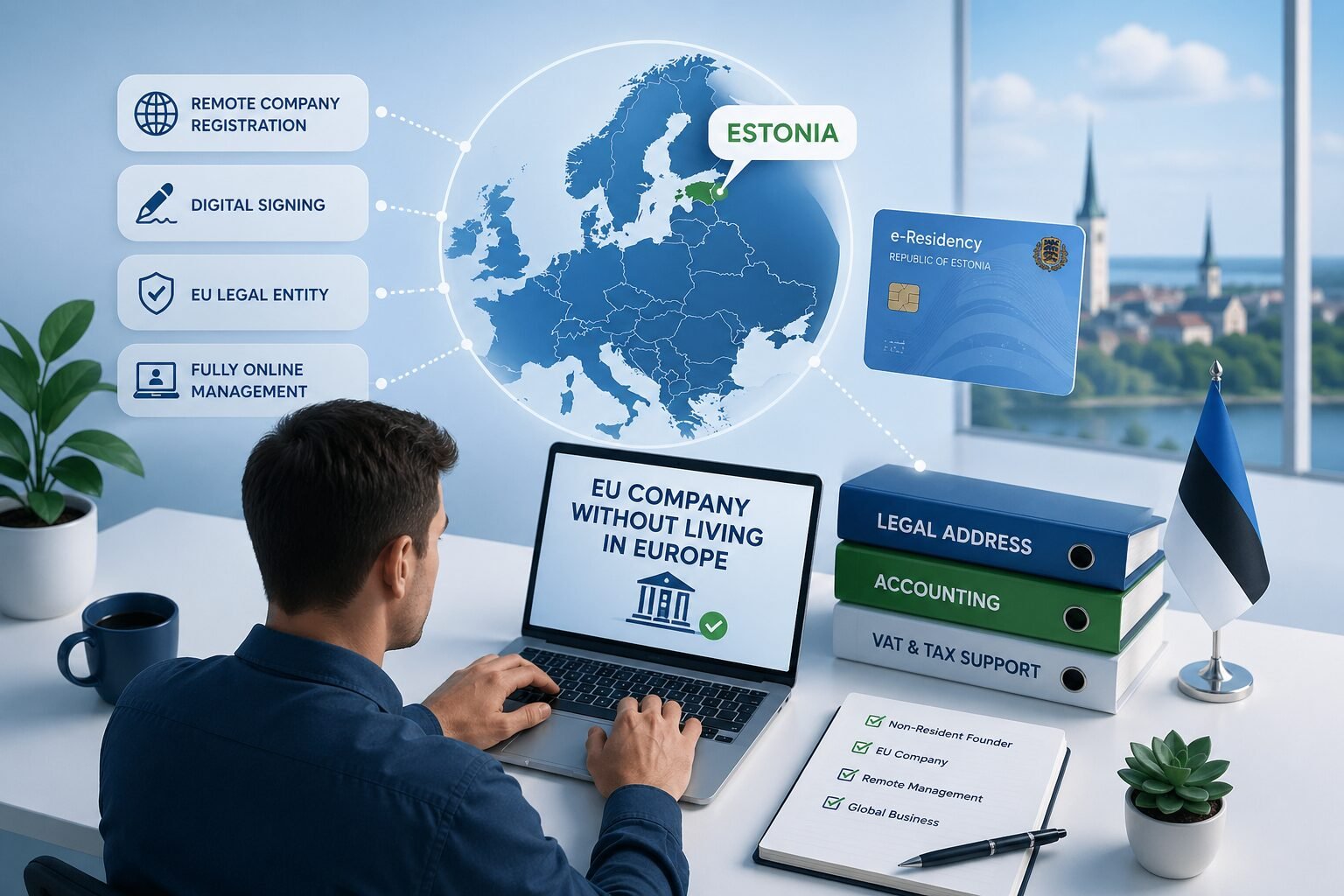
Many non-resident founders want to open an EU company without living in Europe, renting a local office, or spending months dealing with traditional bureaucracy. For digital businesses, consultants, SaaS projects, online agencies, e-commerce operators, and international service providers, the practical question is simple: can you legally create and manage a European company without EU residency?
The short answer is yes, in many cases. A foreign founder can often own and manage an EU company remotely. However, company ownership, immigration status, tax residency, banking, VAT, legal address, and ongoing compliance are separate matters. Opening a company is only the first step. The more important question is whether the company can be managed properly after registration.
Estonia is often considered one of the practical options for remote-first founders who need a European company, digital administration, and a clear legal structure. It is not the only possible jurisdiction, but it may be especially relevant when the business is international, digital, and does not require a large physical presence in another country.
Can a Non-Resident Open a Company in Europe?
In many European countries, foreign founders are allowed to own a company even if they do not live in the country where the company is registered. This means that a person from outside the EU may become a shareholder, founder, or board member of a European company, depending on the rules of the chosen jurisdiction.
However, the practical requirements differ from country to country. Some jurisdictions may require a notarial visit, local representative, local director, registered address, or physical presence for certain steps. Others offer more flexible digital procedures and remote administration options.
For this reason, the question should not be limited to whether company ownership is legally possible. A founder should also understand whether the company can be registered, managed, maintained, and used in real business without unnecessary friction.
Ownership, management, and residence are different concepts
A common mistake is to assume that company ownership, management, residence, and taxation are the same thing. They are not.
A shareholder owns the company’s shares. A board member or director manages the company. A personal tax resident is an individual taxed under the rules of a particular country. A company tax resident is a company taxed according to corporate tax rules. Immigration status determines whether a person has the right to live, work, or stay in a country.
These concepts may overlap, but they should not be confused. Owning an EU company does not automatically give a founder the right to live in the EU. At the same time, a person does not always need to live in the EU in order to own a European company.
Opening a company does not mean relocation
Opening an EU company as a non-resident does not automatically create a right to live in Europe, work in the EU, or become a tax resident of the country where the company is incorporated. These issues should be assessed separately.
This distinction is important for founders who want a European business structure but do not plan to relocate. It is also important for founders who do want to move to Europe, because company formation and immigration planning are not the same process.
What Does Remote EU Company Formation Actually Mean?
Remote company formation can mean different things depending on the country and the method used. It does not always mean that the founder personally fills in an online form and receives a company in a few minutes.
In practice, remote company formation may involve digital signing, e-Residency, power of attorney, notarial procedures, a professional service provider, or a combination of these options. The best method depends on the founder’s nationality, location, business model, number of shareholders, management structure, and preferred jurisdiction.
For founders who are still comparing broader market-entry options, it may be useful to read more about starting a company in Europe before choosing a specific country.
Online registration vs registration by power of attorney
Online registration is usually the most convenient option when all required parties can sign documents digitally. Estonia is well known for this approach, especially through e-Residency and digital business administration.
Registration by power of attorney may be used when the founder cannot or does not want to handle the process personally. In that case, a representative may help prepare and submit documents according to the applicable legal procedure.
Both options can be remote, but they are not the same. Online registration usually gives the founder more direct control over future digital administration, while registration through a representative may be more suitable when e-Residency or another supported digital signing method is not yet available.
Estonia as a Practical Option for Remote Founders
Estonia is often considered one of the most practical EU jurisdictions for non-resident founders who want to manage a company remotely. The reason is not only that company registration can be digital. The broader advantage is that many post-registration actions can also be handled online.
An Estonian private limited company, or OÜ, is commonly used by small and medium-sized businesses, online entrepreneurs, consultants, agencies, IT specialists, and technology companies. For many international founders, it offers a clear corporate structure, EU legal presence, and relatively efficient administration.
Estonia may be especially relevant when the founder needs a European company, remote administration, legal address support, accounting, VAT assessment, and a structure suitable for international online business.
If Estonia fits your business model, Eesti Firma can help you register a company in Estonia with legal support, document preparation, and remote setup assistance.
When Estonia works especially well
Estonia may be a strong fit for businesses that are digital, international, and not tied to a large physical presence in another country.
- SaaS and software projects;
- IT services and development teams;
- consulting and professional services;
- marketing and digital agencies;
- online education and digital products;
- international B2B services;
- remote-first business structures.
In these cases, the founder usually needs a credible EU company, official legal structure, proper accounting, VAT assessment, and the ability to sign and manage documents remotely.
When Estonia may not be the best fit
Estonia is not the right solution for every business. If the company needs a warehouse, office, retail location, staff, or a regulated licence in another country, another jurisdiction may be more suitable.
For example, a business operating mainly in Germany, France, Spain, or another local market may need to consider whether local substance, tax presence, employment, or licensing requirements make a local company more appropriate.
For a broader jurisdiction-level comparison, see our guide on where to set up a company before making a final decision.
Remote EU Company Formation: Key Practical Factors
The best country for remote company formation is not always the country with the fastest registration process. Founders should also consider what happens after the company is created: administration, banking, taxation, address, reporting, and real business use.
For many non-resident founders, the key question is not only where the company can be registered, but where it can be managed properly after registration. Estonia is often attractive because digital administration, legal address, contact person, and accounting support can be combined in one practical setup.
Is e-Residency the Same as Company Registration?
No. E-Residency is not the same as company registration. It is also not citizenship, a residence permit, a visa, or a tax status.
E-Residency is a digital identity that allows a person to access Estonian e-services and sign documents online. It can be very useful for remote founders, but receiving e-Residency does not automatically create a company. The company must still be registered as a separate legal entity.
This distinction is important because many founders confuse three separate things: e-Residency, Estonian company ownership, and the right to live in Estonia or the EU. These are different legal concepts.
Do you need e-Residency to open an Estonian company?
E-Residency is often the most convenient route for remote founders, but it is not the only possible way to establish an Estonian company. Depending on the situation, other methods may be available, including procedures involving a representative or notarial documents.
However, if the founder wants to manage the company remotely in the long term, e-Residency can be useful because it allows digital signing and access to many Estonian online services.
What Do You Need to Open an EU Company Remotely?
Before opening an EU company remotely, founders should prepare more than just a company name. A proper setup requires a clear business model, ownership structure, and administrative plan.
In most cases, founders should consider who the shareholders will be, who will manage the company, what business activities the company will perform, where the company will have its official address, whether a contact person is required, how documents will be signed, how accounting will be organised, whether VAT registration may be needed, and how banking or payment account onboarding will be handled.
The more international the business is, the more important it becomes to prepare the structure correctly from the beginning.
Documents and information usually required
The exact list depends on the jurisdiction and service provider, but founders are usually asked to provide personal identification details, residential address, contact information, planned business activity, shareholder information, management details, and beneficial ownership information.
Banks and payment institutions may request additional documents, such as a business description, website, contracts, invoices, source of funds information, and expected transaction flows.
This is why company formation should not be treated as a purely technical formality. A company that is easy to register may still face problems later if its business model, documentation, or compliance profile is unclear.
Legal Address and Contact Person
An EU company generally needs an official registered address. This address is used for official communication, registry purposes, and legal correspondence. It does not always have to be a physical office where the company conducts its daily business, but it must be valid and properly maintained.
In Estonia, a legal address can be arranged through a professional service provider. In some cases, a contact person may also be required, especially when the company’s management board is located outside Estonia.
A contact person does not manage the company and does not replace the board. The role is administrative: receiving and forwarding official documents and ensuring that the company can be contacted by Estonian authorities.
For remote founders, legal address and contact person services are often essential parts of a compliant company setup.
Banking, Payment Accounts, and Compliance Reality
Opening a company and opening a bank or payment account are different processes. A company may be registered successfully, but this does not mean that a bank account is automatically guaranteed.
Banks and payment institutions review the company’s risk profile. They may look at the owners, directors, countries involved, business model, website, contracts, expected turnover, source of funds, and transaction logic.
This is especially important for non-resident founders. A well-prepared company profile can make onboarding more understandable, while vague or inconsistent information can create delays or refusals.
In some cases, an electronic money institution or payment service provider may be more practical than a traditional bank at the initial stage. The right option depends on the business model and compliance profile.
VAT and Tax Considerations for Non-Resident Founders
Company registration is not the same as tax planning. A founder may open an EU company remotely, but taxation still depends on the company’s activity, clients, management, place of effective control, turnover, and cross-border operations.
VAT may become relevant if the company sells goods or services in the EU, reaches registration thresholds, provides digital services, or works with clients in different countries. The exact treatment depends on the business model.
It is also important to separate personal taxation from company taxation. A founder’s personal tax residency does not automatically change because they own an EU company. At the same time, the company’s tax obligations must be assessed separately.
For this reason, non-resident founders should not choose a jurisdiction based only on registration speed. The company should be suitable for the real business activity and manageable from a tax and compliance perspective.
Should You Open an EU Company Without Living in Europe?
Opening an EU company without living in Europe can be a good solution, but only when the structure matches the business reality.
For some founders, an EU company gives access to European clients, improves credibility, simplifies contracting, and creates a more stable legal structure. For others, it may create unnecessary administration if the business is actually local, regulated, or tax-connected to another country.
If your main question is country selection rather than remote formation, our article on the best country to start your business may be more relevant.
It may be a good idea if
Opening an EU company remotely may be suitable if you run a digital or international business, work with B2B clients, provide online services, need a European legal entity, and want to manage administration remotely.
It may also be suitable if your business does not require a physical office, warehouse, employees, or licence in another specific country.
It may not be the right solution if
A remote EU company may not be the right solution if your main operations are physically located in another country, your business needs a local licence, you require a residence permit, or your tax position is unclear.
It may also be unsuitable if banks or payment providers are unlikely to accept the business model without additional substance, documentation, or compliance preparation.
The right decision should be based on the business model, not only on the desire to register a company quickly.
How Eesti Firma Can Help
Instead of offering only a generic incorporation service, Eesti Firma helps non-resident founders assess whether Estonia is suitable for their real business model, prepare the company structure, organise legal address and contact person services, and support post-registration compliance.
Our team assists with Estonian company formation, document preparation, legal address and contact person services, accounting setup, VAT-related guidance, and ongoing corporate support. The goal is not only to create a company, but to make sure the structure can be used properly for remote and international business.
If you are ready to move from planning to execution, our company formation in Estonia service can help you structure and register your Estonian OÜ properly.
FAQ | Frequently Asked Questions
Below are answers to commonly asked questions about starting, managing, and operating a business, based on typical inquiries received by our specialists.
- Can I open an EU company without living in Europe?
Yes. In many cases, a non-resident founder can open and own an EU company without living in Europe. The exact process depends on the country, signing method, registered address, company structure, tax position and banking requirements.
- Do I need EU residency to start a company in Europe?
Usually no. EU residency is not always required to own or start a company in Europe. However, company formation does not give you the right to live, work or stay in the EU.
- Can a non-resident manage an EU company remotely?
Often yes. Remote management may be possible through digital signatures, online registry access, professional service providers, accounting support and proper compliance procedures. The available options depend on the chosen jurisdiction.
- What is the difference between opening an EU company and relocating to Europe?
Opening an EU company creates a legal business entity. Relocation concerns your personal immigration status. A company does not automatically provide a visa, residence permit, work permit or personal tax residency.
- What do non-resident founders need to open an EU company?
They usually need identification details, a clear business activity, ownership and management structure, official registered address, signing method, accounting setup and a plan for banking, payments, VAT and compliance.
- Is an EU company suitable for every online business?
No. An EU company may be useful for international, digital and B2B businesses, especially when European credibility matters. It may be less suitable if the business is local, regulated, tax-connected to another country or requires physical operations elsewhere.
Note: The FAQ is provided for general informational purposes only and does not constitute legal, tax, or financial advice. Requirements and procedures may vary depending on jurisdiction, business model, and individual circumstances.