Choosing between Estonia and Ireland for a SaaS or tech company is not only about tax rates, incorporation speed, or international reputation. For digital founders, the more important question is which jurisdiction fits the real operating model behind the business: remote management, software development, international sales, reinvestment, banking, compliance, and long-term scalability.
Ireland is one of Europe’s most recognised technology jurisdictions. It is known for its English-speaking business environment, international reputation, strong professional services sector, and the presence of major global technology companies. For larger structures, venture-backed companies, Irish headquarters, and businesses that need a strong English-speaking EU base, Ireland can be a serious option.
Estonia, however, often works better for lean SaaS businesses, remote-first tech founders, software companies, online agencies, and digital service providers that want a practical EU company without building a heavy local structure from day one. For many international entrepreneurs, company formation in Estonia offers a flexible way to start and manage a European business remotely.
Why SaaS and Tech Founders Compare Estonia and Ireland
Estonia and Ireland are often compared because both countries have strong associations with technology and international business. However, they are strong for different reasons.
Ireland is widely recognised as a tech jurisdiction because many global technology companies have chosen it for European operations, headquarters functions, or regional corporate structures. It offers an English-speaking legal and business environment, a well-known corporate tax framework, and a mature market of legal, accounting, tax, and corporate service providers.
Estonia is recognised for a different reason. It is known for digital governance, remote company administration, e-Residency, efficient public services, and a business environment that is especially attractive for smaller international companies. For SaaS founders, software developers, digital consultants, and online service providers, this practical simplicity can matter more than global brand recognition.
In other words, Ireland may be stronger when a company needs scale, local substance, investor familiarity, or a larger operational structure. Estonia may be stronger when the company is founder-led, remote-first, digital, and focused on efficient EU market access.
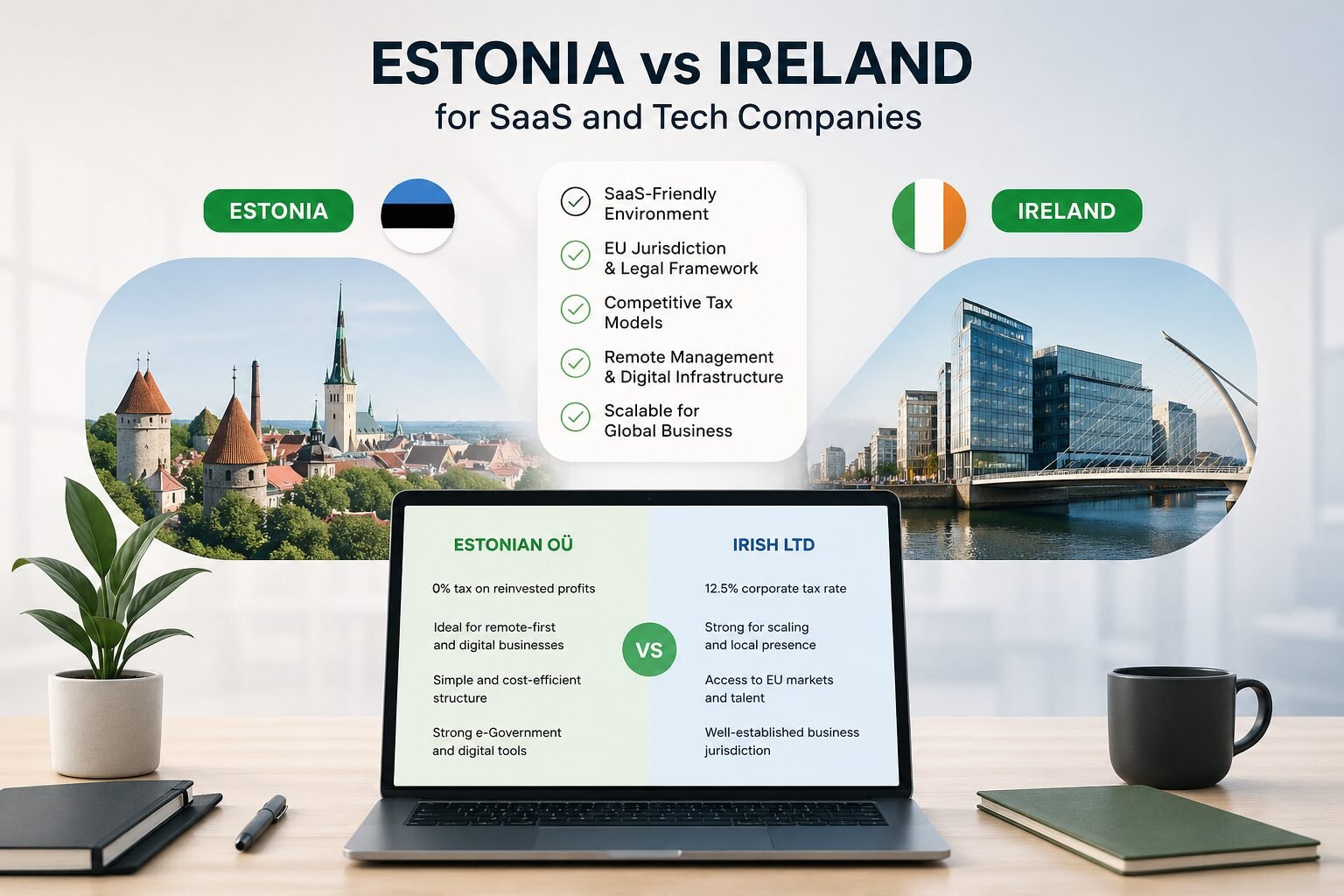
Estonia vs Ireland: Quick Comparison for SaaS and Tech Companies
For SaaS and tech founders, the right jurisdiction is not always the most famous one. The better choice is usually the country that supports the company’s real business model after incorporation.
For many SaaS companies, this comparison leads to a simple practical question: do you need a famous tech headquarters jurisdiction, or do you need an efficient EU company that can support a lean digital business model from the start?
Company Types Compared: Estonian OÜ vs Irish LTD
For SaaS and tech founders, the most relevant company type comparison is usually between the Estonian OÜ and the Irish LTD. Both are limited liability company structures, but they are often used in different practical contexts.
The Estonian OÜ is usually more associated with lean, digitally managed, international business structures. The Irish LTD is often associated with traditional private company operations, Irish market presence, investor-backed structures, and headquarters-oriented planning.
Estonian OÜ for SaaS and digital businesses
The Estonian OÜ is the standard private limited company used by many small and medium-sized businesses in Estonia. It is also a common choice for international founders who want to operate a company from abroad while maintaining a credible EU business structure.
For SaaS companies, an OÜ can be a practical format because the business model is usually digital by nature. The product is online, clients may be international, the team may be remote, and the company may not need a traditional office or local workforce at the beginning.
An Estonian OÜ may be suitable for:
- SaaS platforms and subscription-based software products;
- software development companies;
- digital agencies and online service providers;
- IT consulting and B2B technology services;
- remote-first startups and founder-led tech companies;
- international businesses selling digital products or services.
Another important advantage is flexibility. Estonia allows a very low minimum share capital for an OÜ, and many administrative processes can be handled digitally. This makes the structure especially attractive for founders who want to keep the company lean and focus resources on product development, sales, marketing, and customer acquisition.
For founders who have already decided that Estonia fits their business model, Eesti Firma can assist with the process to register an Estonian company and prepare the structure for practical business use.
Irish LTD for tech companies
The Irish LTD is the common private limited company structure in Ireland. It is widely used for commercial businesses and can be suitable for technology companies, especially where there is a clear reason to choose Ireland.
Ireland may be attractive for tech companies because of its English-speaking environment, international reputation, professional services ecosystem, and recognition among investors and larger corporate groups. For companies planning to build a substantial Irish presence, hire locally, raise investment, or establish a European headquarters, the Irish LTD may be a strong option.
However, for smaller SaaS businesses and remote-first founders, Ireland can be more than they need at the early stage. If the company has no specific link to Ireland, no local team, no investor requirement, and no headquarters strategy connected to the country, the practical benefits may be less obvious.
That does not make Ireland a weak choice. It simply means that Ireland is often better suited for companies with a stronger operational, investment, or strategic reason to be there.
Tax Logic: Ireland’s 12.5% Trading Tax vs Estonia’s Distribution-Based Model
Tax is one of the main reasons founders compare Estonia and Ireland. However, the comparison should not be simplified too much.
Ireland is known for its 12.5% corporation tax rate on trading income. This is one of the reasons Ireland has become attractive for international business. For many profitable trading companies, the Irish tax system is clear, recognised, and familiar to global investors and advisors.
Estonia works differently. In Estonia, corporate income tax generally arises when profits are distributed, for example as dividends, rather than when profits are retained and reinvested in the company. This can be very attractive for SaaS and tech businesses that plan to reinvest earnings into development, marketing, hiring, infrastructure, or international expansion.
For example, a bootstrapped SaaS company may want to use early profits to improve the product, pay developers, run advertising campaigns, attend industry events, or build new features. In such a case, Estonia’s tax logic may support a growth-oriented model because retained and reinvested profits are not usually taxed in the same way as under a traditional annual corporate tax system.
This does not mean that Estonia is “tax-free.” It also does not mean that Estonia is automatically better in every case. The correct tax result depends on the company’s activity, management, substance, founders’ tax residency, profit distribution, and cross-border tax rules. But for many SaaS founders, Estonia’s system can be commercially attractive because it gives the company more room to reinvest during the growth stage.
Remote Management and Digital Administration
For SaaS and tech companies, administration is not a secondary detail. It affects how quickly the company can operate, how easily decisions can be made, how much time the founder spends on paperwork, and how convenient it is to manage the business from abroad.
Estonia is especially strong in this area. The country’s digital infrastructure makes it possible to handle many company-related matters remotely. This is one of the reasons Estonia is attractive to non-resident founders, e-residents, digital entrepreneurs, and international service providers.
For a remote-first SaaS company, this can be a significant advantage. The founder may live outside Estonia, the development team may work from several countries, and clients may be located across the EU, the UK, the US, or other markets. In this type of business, a digitally manageable EU company can be more useful than a jurisdiction that requires a heavier local setup.
Ireland can also be managed by non-resident founders in many cases, but the process is often more traditional. Depending on the situation, the company may rely more heavily on local advisors, registered office providers, tax professionals, and administrative intermediaries. For larger companies this may not be a problem. For lean founders, it can increase complexity and cost.
For founders still comparing broader market-entry options, it may be useful to read more about starting a company in Europe before choosing a specific jurisdiction.
Which Jurisdiction Is Better for Different SaaS and Tech Scenarios?
There is no single answer for every SaaS or tech company. The right choice depends on the company’s stage, business model, funding strategy, team structure, and commercial priorities.
Early-stage SaaS founder
For an early-stage SaaS founder, Estonia is often more practical. The company can be established as a lean EU structure, managed remotely, and used for international sales without immediately building a large local operation.
This is especially relevant when the founder wants to test the product, start selling subscriptions, work with international clients, and keep administrative costs under control.
Ireland may still be relevant if the founder has investors, partners, or market reasons specifically connected to Ireland. But if the company is remote-first and does not need an Irish presence, Estonia may be easier to justify.
Bootstrapped software business
A bootstrapped software business usually needs to protect cash flow. Early revenue is often reinvested into product development, hosting, marketing, contractors, support, and customer acquisition.
In this scenario, Estonia’s distribution-based corporate tax logic can be attractive. If profits are retained and used for business growth, the company may have more flexibility than in a traditional annual profit taxation system.
Ireland may still be suitable for profitable trading businesses, but the company should be ready for a more conventional corporate tax and compliance environment.
Venture-backed startup
For a venture-backed startup, the answer is more nuanced. Ireland can be attractive because it is familiar to many international investors and has strong recognition as a technology jurisdiction. If investors prefer Ireland, or if the company plans to create an Irish headquarters, the Irish LTD may be appropriate.
Estonia can also work for startups, especially at the early stage or for founder-led businesses that value digital administration. However, if the company is preparing for institutional funding, the legal structure should be reviewed carefully before incorporation or restructuring.
Digital agency or software development company
For a software development company, digital agency, or IT consulting business, Estonia is often a strong fit. These businesses are usually service-based, international, and remote-friendly. They often need a credible EU company, clear invoicing, practical administration, and manageable compliance rather than a large local corporate structure.
Ireland may be useful if the agency has Irish clients, an Irish team, or a specific commercial reason to operate from Ireland. Otherwise, Estonia may provide a more efficient setup for international work.
Larger tech company or European headquarters
Ireland may be the stronger option for a larger technology company that needs a recognised European headquarters, a local team, deeper professional services support, or a structure familiar to global investors and multinational groups.
In this context, Ireland’s reputation is a real advantage. For companies with scale, substance, and clear operational reasons, the additional complexity may be justified.
Estonia can still be useful for international tech businesses, but it is usually strongest where the company values digital efficiency, remote management, and lean administration.
Estonia vs Ireland for Non-Resident SaaS Founders
For non-resident SaaS founders, the best jurisdiction is not always the most famous one. It is the jurisdiction that best matches the way the business actually operates.
If the company is remote-first, founder-managed, digital, and focused on international clients, Estonia may be the more practical option. It offers a clear EU base, efficient administration, and a company structure that works well for many online businesses.
If the company needs an English-speaking headquarters, Irish market presence, local hiring, investor preference, or a larger corporate setup, Ireland may be the better choice.
This is why the decision should be based on business substance, not only reputation. A SaaS company should consider where its management is located, where the founders are tax residents, where the team works, where clients are based, how profits will be used, and what kind of corporate image the company needs.
When Estonia May Be the Better Choice
Estonia may be the better choice for a SaaS or tech company when the business is designed to be lean, digital, and international from the start.
This is often the case when:
- the founder is non-resident;
- the business sells SaaS, software, digital services, or online consulting;
- the team works remotely;
- the company does not need a physical office in Ireland;
- profits are likely to be reinvested into growth;
- simple digital administration is important;
- the founder wants an EU company without unnecessary operational weight;
- the company needs a practical structure for international invoicing and contracts.
For many early-stage SaaS founders, Estonia offers a good balance between EU credibility, administrative efficiency, and flexibility. It is not only about forming a company quickly. It is about choosing a structure that remains manageable after incorporation.
When Ireland May Be the Better Choice
Ireland may be the better choice when the company has a real strategic reason to be there.
This may include situations where:
- the company plans to build an Irish or English-speaking EU headquarters;
- investors prefer an Irish structure;
- the business needs local employees in Ireland;
- there are important Irish clients, partners, or commercial links;
- the company wants to benefit from Ireland’s strong reputation in the global tech sector;
- the business is large enough to justify higher advisory and administrative costs.
Ireland can be a very strong jurisdiction for technology companies, especially where the company has scale or clear substance. The key question is whether those advantages are relevant to the founder’s actual business model.
For a small remote SaaS company, Ireland’s reputation may be attractive but not necessarily essential. For a larger venture-backed or headquarters-driven company, that reputation may be commercially valuable.
Estonia or Ireland: Which Is Better for a SaaS Company?
For SaaS and tech companies, the better jurisdiction depends on the company’s stage and strategy.
Ireland is a recognised technology hub with strong international credibility. It may be a strong option for companies that need investor familiarity, an English-speaking EU base, local hiring, or a larger headquarters structure.
Estonia is often more practical for lean SaaS founders, remote-first teams, software companies, digital agencies, and online service providers that want an efficient EU company with digital administration and a business-friendly reinvestment logic.
A founder choosing between Estonia and Ireland should not ask only which country is more famous. The better question is which country supports the company’s real operating model.
If the business is digital, international, and remote from the beginning, Estonia may offer a more efficient and founder-friendly path. If the business needs scale, local Irish substance, or investor-driven structuring, Ireland may be the better fit.
For a broader comparison, founders can also review how to choose the best place to set up a company and assess the best country to start your business before making a final decision.
How Eesti Firma Can Help
Eesti Firma helps international founders assess whether Estonia is suitable for their SaaS, software, or digital business model. The goal is not only to create a company, but to make sure the structure can be used properly for remote and international operations.
Our team can assist with Estonian company setup, legal address and contact person services, document preparation, accounting support, VAT-related guidance, and ongoing corporate administration.
If you are comparing Estonia and Ireland, we can help you understand whether an Estonian OÜ is a practical fit for your business model, or whether another EU jurisdiction should be considered before making a final decision.
FAQ | Frequently Asked Questions
Below are answers to commonly asked questions about starting, managing, and operating a business, based on typical inquiries received by our specialists.
- Is Estonia or Ireland better for a SaaS company?
Estonia is often better for lean, remote-first SaaS companies that need simple digital administration, EU presence, and flexibility for reinvesting profits. Ireland may be stronger for larger tech companies, investor-backed structures, Irish headquarters, or businesses with real local substance.
- Why do tech companies choose Ireland?
Tech companies often choose Ireland because of its English-speaking business environment, international reputation, strong professional services sector, and recognition among investors. It can be especially suitable for larger companies that need an Irish or EU headquarters, local hiring, or a well-known corporate base.
- Why do SaaS founders choose Estonia?
SaaS founders often choose Estonia because it supports remote company management, digital administration, and a lean EU company structure. Estonia can be practical for software companies, digital agencies, IT consultants, and remote-first founders who do not need a large physical presence in another country.
- What is the difference between an Estonian OÜ and an Irish LTD?
An Estonian OÜ is a private limited company commonly used by entrepreneurs, online businesses, and international founders in Estonia. An Irish LTD is a private company limited by shares commonly used for commercial businesses in Ireland. Both offer limited liability, but the Estonian OÜ is often more practical for remote-first digital businesses, while the Irish LTD may suit larger or Ireland-focused structures.
- Is Estonia’s tax system better for SaaS companies than Ireland’s?
It depends on the business model. Ireland generally applies corporation tax to trading profits annually, while Estonia generally taxes corporate profits when they are distributed. For SaaS companies that reinvest profits into product development, marketing, hiring, or growth, Estonia’s model may be more flexible. Tax advice should be taken before choosing a structure.
- Can a non-resident founder open a SaaS company in Estonia or Ireland?
In many cases, a non-resident founder can own a company in either Estonia or Ireland. The practical difference is administration. Estonia is often more convenient for remote-first founders because many company-related actions can be handled digitally, while Ireland may involve a more traditional setup with stronger local advisor involvement.
Note: The FAQ is provided for general informational purposes only and does not constitute legal, tax, or financial advice. Requirements and procedures may vary depending on jurisdiction, business model, and individual circumstances.