Choosing between Estonia and Cyprus is not only a question of where it is easier to register a company. For international founders, investors, holding company owners, and cross-border business groups, the more important question is practical: which EU jurisdiction better fits the way your business earns income, reinvests profits, distributes dividends, manages substance, and operates internationally?
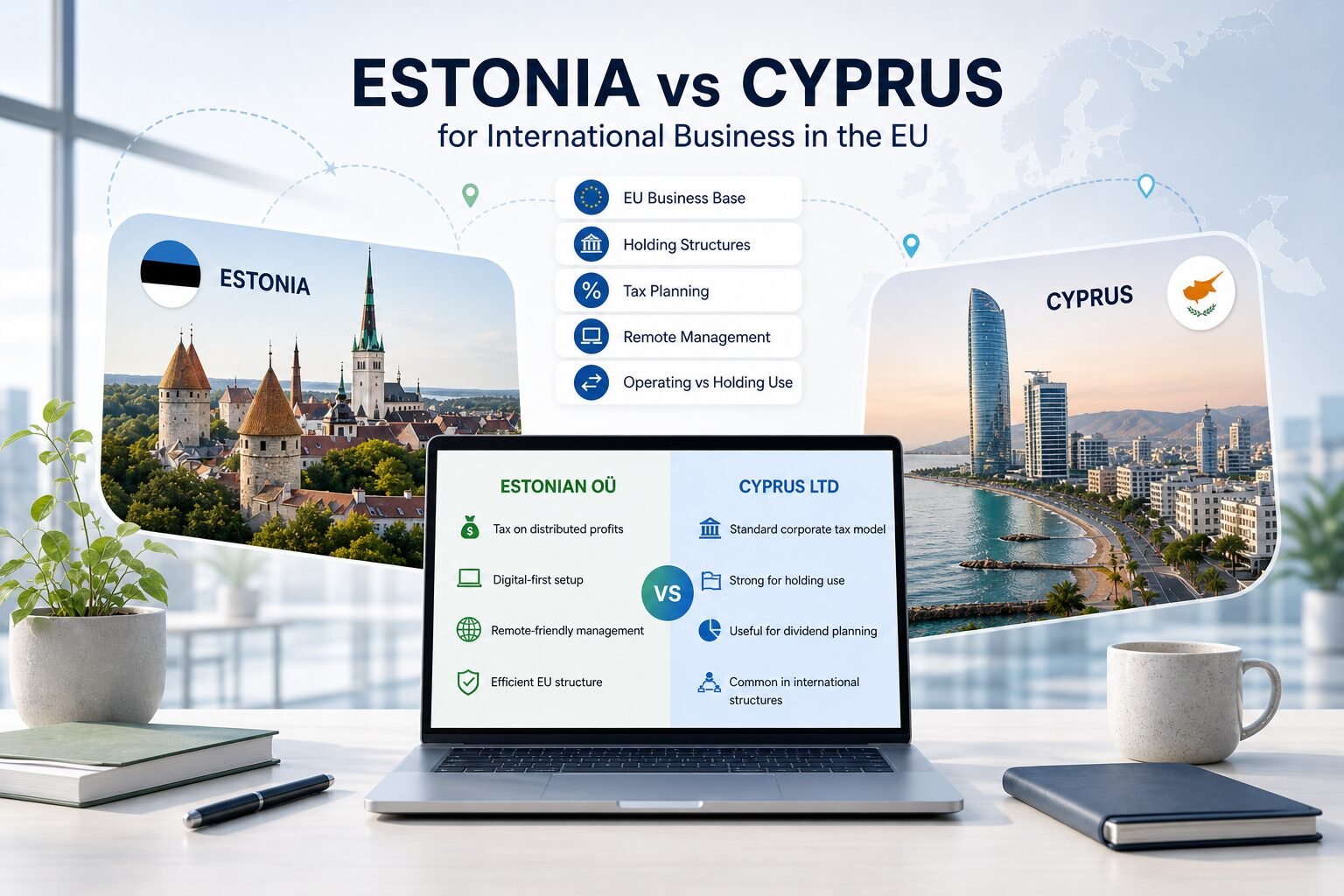
Both Estonia and Cyprus are EU member states. Both can be used for international business, but they are often selected for different purposes: Estonia for active operating companies, and Cyprus for holding, investment, and dividend-oriented structures. Estonia is often stronger for lean, digitally managed operating companies, especially where profits are reinvested into business growth. Cyprus is often considered for holding, investment, dividend, and international tax planning structures where substance and tax residency require deeper analysis.
This guide compares Estonia and Cyprus from the perspective of EU tax, holding structures, company types, remote management, and international business. It is not a generic incorporation manual, but a practical decision-making framework for founders who want to choose the right EU jurisdiction for their actual business model.
Estonia vs Cyprus: Two Different EU Business Logic Models
Estonia and Cyprus should not be compared only by headline tax rates. Their systems are built around different business logic.
Estonia is known for digital administration, e-Residency, efficient company management, and a corporate tax model where tax is generally triggered when profits are distributed. This can be especially useful for businesses that want to keep profits inside the company and reinvest them into growth, software development, hiring, marketing, or international expansion.
Cyprus, by contrast, has traditionally been associated with holding structures, investment planning, dividend flows, and international tax structuring. Its system is closer to a conventional corporate tax model, where company profits are generally subject to corporate income tax.
This difference is important. Estonia is usually more attractive when a company plans to actively operate, invoice clients, manage services, and reinvest earnings. Cyprus may be more relevant where the main purpose is to hold shares, receive dividends, manage investments, or structure group income.
For founders comparing several European jurisdictions, this Estonia-Cyprus comparison can also be read together with a broader guide on the best place to set up a company.
Quick Comparison: Estonia vs Cyprus for EU Business
The table below gives a practical overview of how Estonia and Cyprus differ for international entrepreneurs, holding structures, and EU business planning.
The practical difference is clear: Estonia is often chosen to operate and grow an international business, while Cyprus is often chosen to structure ownership, investment, and dividend flows.
Estonia’s Deferred Taxation vs Cyprus Corporate Tax
Tax is one of the main reasons founders compare Estonia and Cyprus. However, the comparison should not be reduced to a simple percentage. The real question is how and when the company is taxed, whether profits will be distributed or reinvested, and what role the company will play in the wider business structure.
Estonia: Tax on Distributed Profits
Estonia is not a tax-free jurisdiction. Its advantage is not the absence of tax, but the timing of taxation.
In Estonia, corporate income tax is generally due when profits are distributed, for example as dividends. This model can be especially attractive for companies that want to reinvest profits into product development, hiring, technology, marketing, or international expansion.
This is why Estonia is often described as having a deferred corporate taxation model: the key issue is not whether tax exists, but when corporate profit is taxed. If the company earns profit but does not distribute it, the Estonian model may provide more flexibility for long-term business building.
This makes Estonia especially interesting for active operating companies, SaaS businesses, IT companies, consulting firms, and online service providers. Estonia is often considered by founders who want a practical EU base for an operating company rather than a passive structure created only for tax reasons.
Cyprus: Standard Corporate Tax and International Planning
Cyprus uses a more conventional corporate tax model. Company profits are generally subject to corporate income tax. This does not mean Cyprus has lost its relevance. Cyprus may still be attractive for international structures, especially where dividend income, capital gains treatment, double tax treaty access, financing, intellectual property, or group structuring are relevant.
However, Cyprus should not be chosen only because of a headline tax rate. For international business, the real outcome depends on the company’s income type, shareholders, management and control, substance, tax residency, and anti-abuse rules.
Holding Company Use: When Cyprus May Be More Suitable
Cyprus has a long-standing reputation as a jurisdiction for holding and investment structures. It is often considered when a company is intended to hold shares in subsidiaries, receive dividends, manage investment income, or act as a parent company in an international group.
For such cases, Cyprus may offer a familiar legal and tax environment for international tax advisors, banks, and corporate service providers. This can be relevant when the structure involves several countries, several shareholders, dividend flows, financing arrangements, or a future sale of assets.
However, a Cyprus holding company should not be treated as a simple “low-tax company”. In modern EU and international tax practice, substance matters. Management and control, board decisions, real activity, local administration, beneficial ownership, source of funds, and commercial purpose may all be reviewed by banks, tax authorities, and counterparties.
In other words, Cyprus may be a strong option for holding structures, but only when the structure is properly planned, documented, and justified.
Operating Company Use: When Estonia May Be Stronger
Estonia is often a better fit when the company is not primarily a holding vehicle, but an active operating business.
This includes companies that provide services, sell software, run online platforms, invoice international clients, reinvest profits, and need a simple EU company that can be managed remotely. For these businesses, Estonia’s digital administration and reinvestment-friendly tax model can be more practical than a structure designed mainly for dividend planning.
For founders who need a digitally managed EU operating company, company formation in Estonia can be a practical route to building a lean European business structure.
Estonia may be especially relevant for:
- SaaS and software companies;
- IT and software development businesses;
- consulting and professional service firms;
- marketing and digital agencies;
- online education and digital product businesses;
- international B2B service providers;
- remote-first founder-led companies.
Estonia may not be the right choice for every holding or investment structure. But for an active EU company that needs clean administration, digital governance, and flexibility for retained earnings, Estonia is often more practical than Cyprus.
Company Types Compared: Estonian OÜ vs Cyprus Ltd
The most common company form for international founders in Estonia is the private limited company, known as an OÜ. In Cyprus, the most widely used structure for private international business is the private company limited by shares, usually referred to as a Cyprus Ltd.
Both forms provide limited liability and can be used for international business. However, they are usually chosen for different reasons. An Estonian OÜ is often preferred for active digital businesses, consulting, SaaS, online services, and remote EU operations. A Cyprus Ltd is often used for holding, investment, trading, and group structuring purposes.
Which company type is more suitable?
An Estonian OÜ is usually more suitable when the company will actively provide services, invoice clients, manage operations online, and reinvest profits. It is a practical form for founders who need an EU company with efficient administration and a clear operating purpose.
A Cyprus Ltd may be more suitable when the company is part of a wider international structure, holds shares in other companies, receives dividends, manages investments, or requires tax treaty analysis. In such cases, substance, management, and control are especially important.
The practical difference is simple: an Estonian OÜ is often chosen to operate a business, while a Cyprus Ltd is often chosen to structure ownership, investment, or group income.
Remote Management, Substance, and Tax Residency
Remote ownership is possible in both Estonia and Cyprus, but remote ownership does not mean that substance can be ignored.
For Estonia, the digital environment makes company administration easier. Many decisions, filings, and corporate actions can be handled electronically. This is one of the reasons Estonia is popular among non-resident founders and international digital businesses.
For Cyprus, remote ownership is also possible, but the management and control of the company is especially important for tax residency and international tax planning. If a Cyprus company is used for holding or treaty-based structuring, questions such as where directors make decisions, where board meetings are held, where real management takes place, and whether the company has sufficient local substance can become crucial.
In both jurisdictions, banks and payment institutions may also review:
- business model;
- source of funds;
- ownership structure;
- customer geography;
- expected transactions;
- tax residency;
- real economic activity;
- contracts and counterparties.
This is why a jurisdiction should not be selected only on paper. The company must fit the actual business model, management structure, compliance profile, and long-term commercial purpose.
Which Jurisdiction Is Better for Different Business Models?
There is no universal answer to whether Estonia or Cyprus is better. The right jurisdiction depends on the function of the company. A company that actively sells services may need a different setup from a company that holds shares, receives dividends, or manages investment income.
SaaS, consulting, and digital services
For SaaS, consulting, software development, online agencies, and digital services, Estonia is often the stronger option. These businesses usually need an efficient EU company, remote administration, simple corporate governance, and the ability to reinvest profits.
Cyprus can also be used for service businesses, but it may be less natural if the main advantage the founder needs is operational simplicity rather than a holding or tax planning structure.
Holding company and dividend flows
For holding companies, dividend flows, and investment structures, Cyprus may be more suitable. It has a long history in international structuring and may be familiar to tax advisors, investors, and cross-border corporate groups.
However, the decision should always be based on proper tax advice. Holding structures are highly sensitive to tax residency, anti-abuse rules, beneficial ownership, substance, and the tax rules of other countries involved.
E-commerce and EU market access
For e-commerce, the answer depends on the business model. If the company sells digital services, manages a remote team, and reinvests profits, Estonia may be attractive. If the structure involves warehouses, local employees, physical goods, regional distribution, or complex tax flows, the analysis may be different.
Founders comparing several options for European market entry may also find it useful to review broader guidance on the best country to start your business.
International group structure
For an international group, Estonia and Cyprus can even play different roles. Cyprus may be considered for holding or investment planning, while Estonia may be more suitable for an operating company, software unit, service provider, or remote EU business base.
The right answer depends on whether the company’s main function is to operate, hold, invest, distribute, or reinvest.
Estonia or Cyprus: Practical Decision Framework
A practical way to compare Estonia and Cyprus is to look at the real role of the company. Is it supposed to run a business, invoice clients, and reinvest profits? Or is it supposed to hold shares, receive dividends, and support a wider group structure?
Choose Estonia if your priority is:
- a practical EU operating company;
- remote digital administration;
- reinvestment of profits;
- SaaS, consulting, IT, or online services;
- simple company management;
- a founder-led international business;
- EU credibility without building a complex holding structure.
Choose Cyprus if your priority is:
- holding shares in other companies;
- dividend and investment income planning;
- international group structuring;
- tax treaty analysis;
- shareholder-level planning;
- investment or asset-holding activity;
- a structure that can support proper local substance.
The key difference is that Estonia is usually more operational, while Cyprus is often more structural. Estonia is often chosen to run a business. Cyprus is often chosen to structure ownership, investment, and flows of income.
For entrepreneurs who are still comparing EU jurisdictions more broadly, a separate review of starting a company in Europe may help clarify which country fits the real business model.
Common Mistakes When Comparing Estonia and Cyprus
Founders often compare Estonia and Cyprus through tax rates only. This can lead to wrong conclusions. The more important question is how the company will actually operate, where management will take place, how profits will be used, and whether the structure can be supported by real substance and documentation.
Looking only at tax rates
A low or attractive tax rate does not automatically make a jurisdiction better. For international business, timing of taxation, tax residency, substance, banking, VAT, dividend flows, and founder residence may matter more than the headline rate.
Using Cyprus without real substance
A Cyprus structure may look attractive on paper, but without proper management, control, and commercial logic, it may create tax and banking risks. This is especially important when the company is used for holding, dividend, or treaty-based planning.
Using Estonia for the wrong purpose
Estonia is strong for active operating companies and reinvestment. It may not always be the best solution for passive holding structures, complex investment flows, or tax planning that depends on treaty access.
Ignoring banking and compliance
Both Estonia and Cyprus are EU jurisdictions, but banking is not automatic in either case. Banks and payment institutions will still assess the company’s real activity, owners, clients, countries, transactions, and compliance profile.
Final Verdict: Estonia vs Cyprus for International Business
Estonia is usually the stronger choice for active international businesses that need digital administration, operational simplicity, and the ability to reinvest profits. It is especially suitable for SaaS companies, consultants, online agencies, IT businesses, and service providers that want a credible EU company without building an overly complex structure.
Cyprus may be more suitable for holding companies, investment structures, dividend flows, and international tax planning. However, it usually requires deeper professional analysis, stronger attention to substance, and careful review of tax residency, management-control rules, and anti-abuse requirements.
In simple terms, Estonia is usually better for running and reinvesting through an EU operating company, while Cyprus is usually more relevant for holding, dividend, and investment planning.
For many founders, the question is not “Which country has the lowest tax?” but “Which jurisdiction fits the real function of the company?”
If the company will actively operate, invoice clients, and reinvest profit, Estonia may be the more practical choice. If the company will mainly hold shares, receive dividends, or form part of a larger group structure, Cyprus may deserve closer analysis.
How Eesti Firma Can Help
Eesti Firma helps international founders assess whether Estonia is the right jurisdiction for their business model, ownership structure, and long-term plans. Our team supports entrepreneurs who need a practical EU company for digital business, consulting, SaaS, international services, and cross-border operations.
If your goal is to register a company in Estonia, we can assist with the practical formation process and related corporate support.
Instead of choosing a jurisdiction only by headline tax rates, it is better to assess how the company will actually operate, earn income, retain profits, distribute dividends, and satisfy banking, tax, and substance expectations. This is where a practical comparison between Estonia and Cyprus becomes especially valuable.
FAQ | Frequently Asked Questions
Below are answers to commonly asked questions about starting, managing, and operating a business, based on typical inquiries received by our specialists.
- Is Estonia or Cyprus better for international business?
Estonia is often better for active international businesses that need a digitally managed EU company, remote administration, and a tax model that supports reinvested profits. Cyprus may be more suitable for holding companies, dividend flows, investment structures, and international tax planning. The better choice depends on whether the company will mainly operate, hold assets, distribute income, or reinvest profits.
- Is Estonia better than Cyprus for a digital business?
Estonia is often more practical for digital businesses, SaaS companies, consultants, online agencies, and IT service providers. An Estonian company can be managed efficiently through digital tools, and retained profits are not taxed immediately at company level. This makes Estonia attractive for founders who want to run and grow an EU business remotely.
- Is Cyprus better than Estonia for a holding company?
Cyprus may be more suitable for certain holding company structures, especially where dividend flows, investment income, group planning, or tax treaty analysis are important. However, a Cyprus holding company usually requires proper substance, management and control, tax residency analysis, and professional structuring. It should not be chosen only because of headline tax advantages.
- What is the main tax difference between Estonia and Cyprus?
The main difference is the timing and logic of taxation. Estonia generally taxes corporate profits when they are distributed, which may support reinvestment. Cyprus follows a more standard corporate tax model where company profits are generally taxed under the corporate income tax system. For this reason, Estonia is often attractive for reinvestment, while Cyprus is often considered for holding and planning structures.
- What is the difference between an Estonian OÜ and a Cyprus Ltd?
An Estonian OÜ is a private limited company commonly used for active business, digital services, consulting, SaaS, and remote EU operations. A Cyprus Ltd is a private company limited by shares and is often used for trading, holding, investment, and group structures. Both provide limited liability, but they are usually chosen for different business purposes.
- Which country is better for reinvesting profits: Estonia or Cyprus?
Estonia is usually more attractive for reinvesting profits because corporate tax is generally triggered when profits are distributed, not simply when they are earned. This can help active businesses keep more funds inside the company for growth, development, hiring, and expansion. Cyprus may still be useful for holding and investment planning, but it is less focused on deferred taxation for operating profits.
Note: The FAQ is provided for general informational purposes only and does not constitute legal, tax, or financial advice. Requirements and procedures may vary depending on jurisdiction, business model, and individual circumstances.