Company Formation in Estonia for International Founders
Company formation in Estonia is one of the most efficient and digitally advanced business registration systems in the European Union. Under the Estonian Commercial Code, companies are registered through the official e-Business Register, allowing founders to establish a private limited company (OÜ) fully online within a few business days.
Register an Estonian OÜ — Fast and EU-Ready
Eesti Firma provides professional company registration services in Estonia for international founders, non-residents and e-residents. As a licensed corporate service provider (TCSP), we ensure that your Estonian OÜ is established correctly and aligned with corporate and tax requirements from the outset.
- ✓0% corporate income tax on retained and reinvested profits
- ✓Remote incorporation via e-Residency or a notarised power of attorney for non-resident founders
- ✓Fully digital company management (e-signatures, e-services and online reporting)
- ✓EU-based company with access to the European Single Market and cross-border business opportunities
- ✓Efficient company registration — typically completed within 1–5 business days
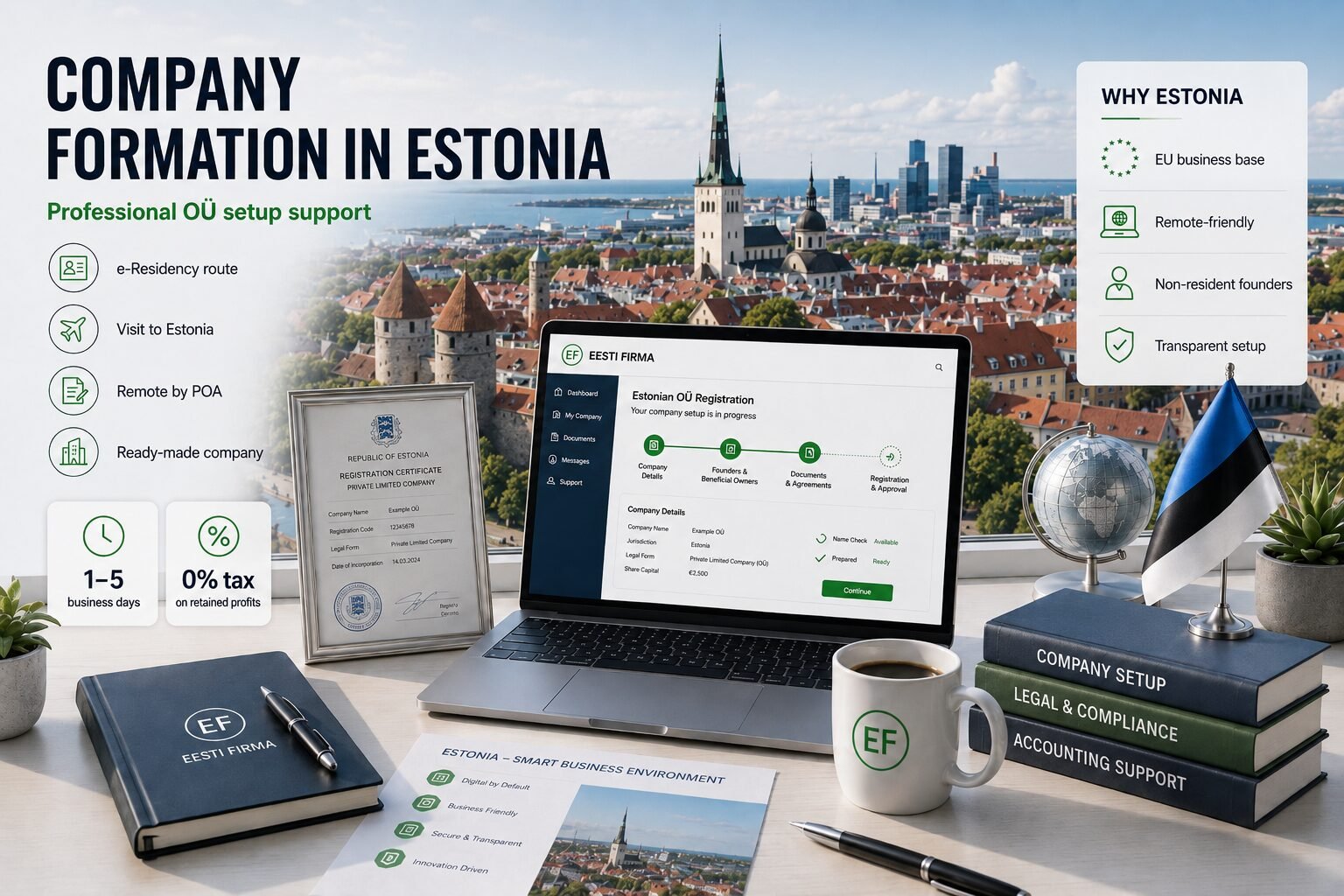
Company Formation in Estonia: Professional OÜ Setup Support
| ✓ | Key information Company formation in Estonia is the registration of a private limited company (OÜ) — the standard legal form for business in the country. Eesti Firma helps international entrepreneurs set up an Estonian OÜ remotely through e-Residency, during a visit to Estonia, or by notarised power of attorney, with practical legal support from the first consultation to the steps that follow registration. A core advantage of the Estonian model: profit reinvested in the company is taxed at 0%, and corporate income tax (22%) applies only when profits are distributed. |
| i | Who this is for Non-resident founders, e-residents and international entrepreneurs who want to open an EU-based company without relocating — including digital and online businesses, cross-border service providers, consultants, SaaS and IT projects, e-commerce sellers, crypto-related and licensed activities, holding structures and companies with several shareholders or more complex setups. |
| ✓ | Legal review of the founder profile, business model and registration route |
| ✓ | Suitable structure — OÜ as the standard option for most international founders |
| ✓ | Incorporation documents prepared per Estonian registry and legal requirements |
| ✓ | Company registration via the e-Business Register or before a notary |
| ✓ | Legal address & contact person arrangements where required for foreign business owners |
| ✓ | Post-registration guidance on VAT, accounting, banking readiness and compliance |
| ★ | Key takeaway Well-structured incorporation reduces registry objections, avoids unnecessary delays and creates a stronger foundation for the company after registration — which matters most for founders managing the business from abroad. |
Estonia is a practical jurisdiction for international entrepreneurs because it combines digital administration, transparent regulation and efficient company registration within the European Union. Below we explain the available registration routes and pricing, who each option suits, the procedural steps, the tax framework and what usually happens after incorporation.
Estonian Company Setup: Registration Options and Packages
The best incorporation route depends on whether you already hold e-Residency, whether you can travel to Estonia and how quickly the company should be ready. Each option below includes clear pricing, defined timelines and professional support — including notary, power-of-attorney and ready-made-company routes that self-service providers rarely offer.

€700
Company Formation Online with e-Residency
This is the most efficient online setup route for founders and board members who already hold a valid e-Residency card or Estonian digital ID. Registration is completed through the Estonian e-Business Register.
- ✅ 100% online registration process
- ✅ No travel to Estonia required
- ✅ Fast and cost-efficient setup route

€850
Company Registration During a Visit to Estonia
This option is suitable for founders who can come to Tallinn and complete the incorporation procedure before a notary. Our team prepares the documents and coordinates the process from start to finish.
- ✅ Personalised legal support
- ✅ Notarial route coordinated for you
- ✅ Practical setup during the visit

€1200
Company Setup Remotely by Power of Attorney
This route allows remote incorporation without personal presence in Estonia. It is based on a notarised power of attorney and is often suitable for founders who do not yet hold e-Residency or cannot travel.
- ✅ No personal presence in Estonia required
- ✅ Practical route for international founders
- ✅ Structured legal coordination throughout the process

€1400
Acquisition of a Ready-Made Estonian Company
A ready-made company may be acquired as an alternative to a new incorporation process. This option can be useful where timing, transaction planning or structural considerations are especially important.
- ✅ Ready-to-use corporate solution
- ✅ Can save time in selected cases
- ✅ Suitable for structured transactions
Additional Services
Supporting services related to company formation, legal compliance and ongoing administration in Estonia. The Basic Package rows below are the formation-only versions of the full packages shown at the top of this page; the full packages additionally include a virtual office (legal address and contact person) for the first year.
| i | Note The company formation fee in Estonia, regardless of the selected setup method, already covers all notary and state fees (including the €265 state registration fee), plus one hour of legal or accounting advice. The full packages at the top of this page (the advanced options) also include a virtual office for one year, while the Basic Package rows above cover formation only — so the first-year setup has no hidden mandatory add-ons; ongoing accounting is quoted separately based on your activity. VAT may apply to the prices shown above. Before proceeding, please review our Pricing Policy and Terms & Conditions. |
Why International Founders Choose Estonia
Estonia is widely regarded as one of Europe’s most efficient jurisdictions for company formation. It pairs fully digital e-government services with clear regulation and a business-friendly legal framework that works especially well for non-resident owners and cross-border business models.
- •Digital administration. Registration, document signing, reporting and much of the ongoing administration can be handled online.
- •Low share capital threshold. An OÜ may be established with share capital starting from €0.01 per shareholder, subject to applicable legal rules.
- •Distribution-based corporate tax model. Retained and reinvested profit is taxed at 0%, and corporate income tax (22%) applies only when profits are distributed.
- •EU business environment. An Estonian company operates within the EU legal framework and may be used for cross-border trade and services.
- •Predictable compliance. Clear company law and digital administration simplify filing, maintenance and communication with authorities.
- •International ownership. The company can be fully foreign-owned, and neither shareholders nor board members are required to be Estonian residents.
These advantages help explain why the OÜ remains the most widely used legal form for entrepreneurs establishing a business in Estonia.
OÜ Setup in Estonia for Non-Residents and Foreign Founders
Estonia is one of the most practical EU jurisdictions for founders who want to establish a company without relocating. Estonian law allows 100% foreign ownership, and no residency requirement applies to shareholders or management board members. Founders from almost any country can open, own and register an Estonian company, including non-EU citizens, with no Estonian-resident director required. As a result, the Estonian OÜ is widely used by non-resident owners who need an EU-based business structure.
International founders commonly use Estonian companies for the following purposes:
- •Digital and online businesses — SaaS, IT services, consulting and remote-first business models.
- •Cross-border services — consultants, agencies and entrepreneurs working with international clients.
- •EU market entry — founders who need an EU company for operations, invoicing or expansion.
- •Holding, multi-shareholder and complex structures — international ownership, several shareholders and corporate setups that need hands-on legal structuring rather than a standard template.
- •E-commerce and modern trade — founders entering the European market through an EU entity.
Non-residents may register an Estonian company through several routes. If founders and board members already hold e-Residency or Estonian digital ID, the process may be completed online through the Estonian e-Business Register. Alternatively, incorporation may be completed before a notary during a visit to Estonia or arranged remotely by notarised power of attorney.
- •No local shareholder required. An Estonian company may be owned by foreign individuals or legal entities — including non-EU founders — and managed from abroad.
- •Registered address is always required. Every Estonian company needs a local registered office, and a local contact person is required where applicable.
- •No travel in every case. Depending on the chosen route, an OÜ may often be incorporated without visiting Estonia.
- •Remote management after incorporation. Once registered, the company can generally be administered online from anywhere in the world, including document signing and communication with authorities.
For founders outside Estonia, an initial legal consultation helps identify the most suitable route based on the founder profile, business model and timeline.
Company Formation in Estonia: Procedural Steps
The incorporation process in Estonia is largely digital, but the exact route depends on whether the founders use e-Residency, need a notarial procedure or prefer remote incorporation by power of attorney. Below is a practical overview of the usual steps.
| ★ | Registration time Estonian company registration is often efficient when documents are properly prepared. Timing depends on the chosen method, the completeness of the application and current registry workload. If you still need to apply for e-Residency, note that issuing the card itself usually takes several weeks (commonly around 3–6) and is separate from the registration time above. |
The registration process usually includes the following steps:
| 1 | Name verification. Choose a unique company name in the Latin alphabet and determine the principal business activity (EMTAK code). Name availability can be checked in the Commercial Register. |
| 2 | Preparation of incorporation documents. Draft the constitutional documents and define the shareholder structure, board composition and key registration details. |
| 3 | Registered address and local arrangements. Every Estonian company must have a local registered address. Non-resident founders may also need a local contact person, commonly provided through a virtual office service. |
| 4 | Submission of the application. The application is submitted through the Estonian e-Business Register, before a notary or by notarised power of attorney, depending on the selected setup route. |
| 5 | Registration approval and next steps. Once approved, the company receives its registry code and may proceed with banking, VAT registration, accounting setup or EORI registration where relevant. |
When the structure and documents are prepared correctly from the beginning, the registration process is usually straightforward and predictable.
Key Considerations Before Registering a Company in Estonia
For most international founders, the standard choice is a private limited company (OÜ). It is the most common legal form in Estonia for commercial activity because it combines limited liability, flexible governance and suitability for remote management. Before registration, it is useful to review several legal, tax and operational factors that may affect both incorporation and future company administration.
- •Share capital and contribution planning. An OÜ may be established with a minimum share capital of €0.01 per shareholder, but contribution mechanics and practical requirements should be reviewed before registration.
- •Ownership and management structure. An OÜ may be founded and managed by one person. Full foreign ownership is permitted, and neither shareholders nor the management board need to be Estonian residents.
- •Corporate taxation. Estonia applies a distribution-based tax model under which profits are generally taxed when distributed as dividends rather than on an annual accrual basis.
- •Banking and payment service readiness. After registration, the company may apply for an account with a bank or EU-based payment institution, subject to internal compliance procedures.
Understanding these points in advance helps founders structure the company properly and avoid practical issues later.
Tax Framework Relevant for Estonian Companies
When planning to establish a company in Estonia, it is useful to understand the main tax elements that become relevant after incorporation. Estonia applies a distribution-based corporate income tax system: profits become taxable only at the point of distribution, while earnings kept in the company are not taxed on an annual basis.
In practice, the Estonian tax system combines a reinvestment-friendly corporate model with straightforward digital administration.
What Usually Happens After Incorporation
Company registration is only the first step. After incorporation, many founders need practical guidance on the next legal and administrative actions required for operating the company smoothly in Estonia and internationally.
- •Banking or EMI onboarding. The registered company may apply for a business account with a bank or payment institution, subject to internal compliance review.
- •VAT and EORI analysis. Depending on the business activity, founders may need VAT registration, EORI registration or both.
- •Accounting setup. Proper bookkeeping and ongoing accounting support are essential from the beginning of operations.
- •Annual reporting and compliance. Every Estonian company must keep records properly and submit annual reporting documents within the statutory time limits.
- •Registered address and contact person continuity. Foreign-managed companies often continue to rely on local address and contact person solutions after incorporation.
This is why many founders prefer a provider that can support not only the registration itself, but also the next operational and compliance stages.
Eesti Firma: Corporate and Legal Expertise
Although incorporating a company in Estonia is relatively straightforward in many cases, professional support helps reduce registry objections, documentation errors and compliance risks. Eesti Firma provides structured assistance for international clients from the planning stage through registration and the next practical steps after incorporation.
- •Licensed and supervised provider. Eesti Firma operates as a licensed Estonian Trust and Company Service Provider (activity licence FIU000144), supervised by the Financial Intelligence Unit (Rahapesu Andmebüroo), and is a member of the Estonian Chamber of Commerce and Industry (ECCI).
- •Proven experience in company formation in Estonia. With more than 10 years of practice and over 5,000 companies registered, our team has broad experience across different founder profiles and business sectors.
- •A full legal and accounting team, not a self-service portal. We combine legal services, accounting and tax advisory in one place and handle cases that automated platforms often decline — multiple shareholders, e-commerce, crypto-related or licensed activities and non-standard structures.
- •Compliance-oriented approach. Our work is aligned with Estonian corporate and tax legislation, helping founders start correctly from the outset.
- •Direct professional communication. Clients work directly with qualified specialists responsible for the matter and the practical steps that follow registration.
- •Ongoing administrative support. We assist with document preparation, notarial procedures, VAT registration, annual reporting and other post-incorporation matters.
For many international entrepreneurs, Eesti Firma becomes a long-term partner in Estonia, supporting both company formation and the ongoing operation of the business.
Initial Consultation and Engagement
An initial consultation helps identify the most suitable route for establishing your company in Estonia based on the founder profile, business model, timeline and operational goals. Eesti Firma provides structured guidance from the very beginning of the process — contact our team to discuss the most suitable registration route, required documents and the practical next steps for your case. You can also browse common questions about companies in Estonia.
Eesti Firma OÜ (registry code 14164797, VAT EE102081480) is a licensed Estonian Trust and Company Service Provider — activity licence FIU000144, supervised by the Financial Intelligence Unit (Rahapesu Andmebüroo) — based at Vesivärava 50, Kadrioru Plaza, Tallinn, serving local and international entrepreneurs, including e-residents, non-resident founders and foreign-managed companies.
Ilja Nikiforov, Head of Eesti Firma OÜ — AML & Data Protection Officer
FAQ | Frequently Asked Questions
Below are answers to frequently asked questions about registering and operating a business in Estonia, based on common inquiries received by our specialists.
- How long does company registration in Estonia take?
Registration is typically processed within 1–5 business days once all required information and documents are submitted. Timelines may vary depending on the chosen method (e-Residency, notary, or POA) and registry workload.
- Can I register an Estonian company remotely?
Yes. Registration can be completed online via e-Residency or remotely by notarised power of attorney (POA). If you prefer, registration can also be done in person before a notary in Tallinn.
- What is an OÜ and why is it the most common choice?
An OÜ (osaühing) is a private limited company where shareholders’ liability is limited to their contributions. It is the most widely used structure for commercial activities due to its flexibility and standard registry practice.
- What is the minimum share capital for an OÜ?
The minimum share capital for an Estonian private limited company (OÜ) starts from €0.01. Contributions may be made in cash to the company’s bank account or in kind, such as property or equipment. Dividend distributions may be restricted until statutory capital contribution rules are satisfied.
- Can a non-resident be a shareholder or board member?
Yes. 100% foreign ownership is permitted, and board members do not need to reside in Estonia. However, banks and payment providers may apply their own due diligence requirements.
- Do I need e-Residency to open an OÜ in Estonia?
No. e-Residency is a convenient online method, but it is not the only option. You can register through a notary visit or by POA if you do not have e-Residency.
- What is Estonia’s e-Residency and how do I apply?
e-Residency is a government-issued digital ID for non-residents that enables access to Estonia’s online business services. Applications are submitted online, and the card is collected at a designated embassy or authorised pickup location.
- Can an Estonian company open a foreign bank or fintech account?
Yes. Estonian companies may open accounts with EU credit institutions or licensed fintech providers, including Wise, Revolut, Wamo and Paysera, subject to each provider’s internal compliance and onboarding procedures.
Note: The FAQ is for general information only and does not constitute legal or tax advice. Requirements may vary depending on your circumstances.